J.C. Alston: A boy at Pearl Harbor

JC Alston
J.C. Alston salutes on Pearl Harbor Day.

A little before 4 a.m. on December 7, 1941, J.C. Alston was wakened by a fellow sailor as he slept in a bunk on the USS California, the lead ship moored to docks adjacent to Ford Island in the middle of Pearl Harbor. It was Alston’s turn to take up watch on the port side of the battleship’s quarterdeck. His shift was from 4 a.m. to 8 a.m.

After waking the officer of the day and the chief boatsmate, Alston stood under a clear dark sky filled with stars and a waning moon. He could see the silhouette of the battleship’s coning tower and its gun batteries. As always, the crew was to awake the captain if they saw any threat, but the eighteen-year-old sailor had never had an occasion to waken him.

Sometime around sunrise, the bugler sounded reveille. The harbor water was so glassy smooth that Alston watched a PBY pontoon plane repeatedly fail to take off from the surface of the harbor’s waters. (PBY is short for “patrol bomber” with the “Y” the military designation for its manufacturer, Consolidated Aircraft.)  Needing choppier water to get lift, a PT (patrol torpedo) boat cruised in circles to create a wake and the seaplane was soon aloft. On the forward deck, sailors put up a white awning for Sunday morning religious services. Small boats arrived with GIs planning to attend. His shift nearly over, Alston was ready for next sailor to relieve him. He was hungry for breakfast.

He then heard the noise of aircraft flying in his direction and saw low-flying planes coming from behind a mountain on Oahu. “I didn’t know they were Japanese at the time. I thought some aircraft carriers were training,” Alston said, remembering that the USS Lexington left the harbor the night before laden with planes.

“Those are Japanese planes!” the boatsmate yelled. “Japanese planes!”

The bugler sounded general quarters calling sailors to their assigned battle stations. Alston’s heart raced as he ran to his, the number two 14-inch-diameter gun on middeck, and slid inside its turret. He was a gun loader. From his darkened space he could hear a barrage of sounds – roaring planes, machine-gun and anti-aircraft fire, sirens. He felt the ship violently rock when it was hit by torpedoes below its water line.

According to the action reports filed after the attack, the California was struck by two torpedoes on its port side at 8:05 a.m. and then blasted by another fifteen minutes later. At 8:10 a.m. Alston heard the loudest explosion: The bomb that blew up the USS Arizona. Blinding smoke filled the sky and fire lapped the water.

Alston’s ship also was nearly hit by four bombs that caused serious flooding and at 8:30 a.m. a bomb penetrated to its second deck where it exploded and sparked a tremendous fire that killed about fifty men.

“Fire was everywhere,” Alston recalled. The listing ship was ordered abandoned because of the threat that that it would blow up. Alston emerged from his turret and joined other sailors to leap from the quarterdeck and swim about twenty yards to nearby Ford Island. Drenched and wide-eyed, the boys were partially hidden by smoke but they could see Japanese planes bombing and strafing. They seemed close enough to throw a rock and hit the low-flying planes, which swooped down and then pulled up at the last second to avoid the towers of the burning battleships. “There were so many I don’t know how they missed each other. They were like a bunch of bees,” Alston said.

On Ford Island, officers mustered their men for roll calls to see who was still alive or missing. Soon, Alston and other sailors were ordered back aboard to man the guns on the California that remained above water. This time they scrambled across timbers that had been laid across to the quay, climbed a ladder, and pulled themselves on board.

In an almost comical confusion of combat, another abandon ship order came minutes later as the ship continued to sink despite valiant efforts to keep her afloat. The inrushing water could not be isolated and the California settled into the mud with only her superstructure above the water.

“Anybody who says they weren’t scared, well, they’re just not quite telling the truth,” Alston said as he told his story in the living room of his home in Troy, Texas. “Of course it hits them after it’s over more than it did at the time.”

Roughly one hundred of the California’s crew died and sixty-one were wounded.

Dying never entered Alston’s mind until that day. He joined the navy just five months before the attack after he had dropped out of high school. He and two buddies hitched a ride to the Dallas recruiting station. Girls were on his mind and the legend of sailors having one in every port, Alston said, smiling at the memory. He also was pragmatic: Finding work during the hard-luck days of the Great Depression was difficult if not impossible. But in the navy, “I’d have a job, three meals a day, a place to sleep and it was warm and dry,” he said.

Alston was born March 3, 1923 in Cone, a hamlet about thirty-five miles northeast of Lubbock. The middle of seven children in a farming family, he grew up during the bitter dust bowl years on the Southern Plains. He remembers when electricity came to the community and they began using light bulbs instead of kerosene lanterns. Alston was a young teen-ager when his parents hung up their plow and moved to Temple in Central Texas. His father became a carpenter.

Even with the threat of war, Alston’s parents voiced no objections to his decision to enlist. Some of Alston’s relatives had already joined the navy, and Alston considered oceanfaring the best choice. On a ship, he wouldn’t have to trudge the frontlines as an Army infantryman. “Why walk when you can ride?” Alston said with a laugh.

After about six weeks in boot camp in San Diego, Alston reported to Long Beach for his first duty on the USS California. He was assigned to the deck crew’s division two, port side, which mostly meant cleaning, painting, and maintaining a section of the six hundred-and-forty-foot-long, 30,000-ton battlewagon. On October 1, 1941, they set sail for Pearl Harbor.

Just nine weeks later, in the midst of the Japanese attack, a frightening thought leaped into Alston’s mind: I could die here. He has no good explanation for why he didn’t. Alston said he and the other boys who escaped from the burning and sunken ships instantly bounded with a common purpose: to avenge the attack that killed thousands of their brother sailors. They slept together on cots in a hangar and then squeezed into barracks or strung up hammocks in ships with less damage. Alston found a berth on the USS Maryland, a battleship that hadn’t sunk despite being hit with a bomb.

In hushed voices, the shell-shocked survivors talked about what war meant, but they had little time to ponder their good fortunate. They were on guard against another attack and they got to work to salvage and help repair America’s devastated Pacific Fleet. Alston was assigned watch duty and manned five-inch guns that were taken off the California and moved to the nearby gunnery range.

In time Alston was assigned to the West Virginia, which was fitted with temporary patches to its hull, refloated, and moved to a dry dock for repairs. He helped hook up hoses to pump tens of thousands of gallons of fuel and oil and contaminated water to barges. He was among a group that went below deck to pull up bedding, furniture, and other debris. They found dead bodies.

“When we came across a body we hollered up ‘There’s a body down here!’ ” Alston recalled. Marine corpsmen and medics clamored down and retrieved the body, placed him in a bag, and carried him away. Alston remembers the stench. “It stunk. That old oil stinks anyway.”

On their uniforms they wore white tape that had been treated with some kind of chemical. This was their canary in the coalmine. If the tape turned purple they were in danger of being asphyxiated by vapors and they were ordered to a platform that another sailor above cranked to carry them out of the hold and into the fresh air.

Alston learned firsthand the sad story of how, in rare moments of quiet after the attack, rescuers had heard faint sounds on the West Virginia. Bang, bang, bang. The noise came from somewhere below. Old-timers told Alston that sailors had been trapped deep below in an compartment that still had some air. They were banging on pipes. But the sailors above were helpless to save them because even if divers could isolate where they were and cut the ship open the pressure and overwhelming surge of water would drown those trapped and possibly kill the would-be rescuers. Bang. Bang. Bang. Salvage crews eventually found the bodies of three men huddled in an airtight storeroom. They hadn’t drowned; they died from a lack of oxygen and may have lived until December 23. The crew found a calendar with them on which sixteen days had been crossed off in red pencil.

In 1943, Alston was on the West Virginia as it sailed back to the West Coast for final repairs and modernization with more weaponry. It returned to service in 1944 as the tide turned in favor of the United States. Alston and the West Virginia took part in major battles that helped America take control of the Pacific: the October 1944 Battle of Leyte Gulf,  the retaking of the Philippines, and the deadly 1945 battles for the strategic islands of Iwo Jima and Okinawa, where thousands of Marines died in gruesome combat against entrenched Japanese soldiers hidden in vast networks of caves.

Off the Philippines, Alston said he watched as five Japanese kamikaze planes plunged from the sky to try to ram into the ship. Four of the suiciders crashed or were shot down. But the fifth crushed into a superstructure deck just forward of a secondary battery, killing four men and injuring seven. Luckily, the aircraft’s bomb didn’t go off and West Virginia crewmembers carefully dislodged the unexploded weapon and dropped it overboard, Alston said.

The ship sailed to New Zealand for repairs and then joined the fleet for the attack on Iwo Jima, where it bombarded Japanese hideouts. On February 23, 1945, from his position offshore, Alston witnessed six GIs raise a U.S. flag on Iwo Jima’s Mount Suribachi, a ceremony that was staged twice. The photograph of the second flag raising captured by Associated Press photographer Al Rosenthal instantly became the war’s most famous shot.

On September 2, 1945, Alston was on the West Virginia’s deck in Tokyo Bay Japanese officials joined Admiral Chester Nimitz, General Douglas MacArthur, other allied commanders on the nearby USS Missouri to sign the instrument of surrender, officially ending the war weeks after the United States dropped atom bombs on the Japanese cities of Hiroshima and Nagasaki.

Alston was discharged in October and returned to Texas. He drifted to Lubbock where he helped a relative harvest wheat and then returned to Temple and landed a job as a truck driver at a Veterans Administration hospital. In 1949, he married a local girl, Arita June, and they had two daughters. He remained at the VA for thirty-four years in a variety of positions, including as fire department crew chief and supervisor of laundry service. After nearly sixty years of marriage, his wife suffered a heart attack and died in February 2008.

It took many, many years before Alston was able to forgive the Japanese, but forgive he has. The widower often tells his story to schoolchildren and attends veterans’ reunions and events. He has returned to Pearl Harbor many times and had served as the president of the Central Texas chapter of the Pearl Harbor Survivors’ Association, which disbanded in 2011 because so few survivors are alive and many of those who remain are too ill or frail to travel.

On December 7, 2012, Alston was one of four Pearl Harbor survivors to attend ceremonies commemorating the battle at the National Museum of the Pacific War in Fredericksburg, Texas. A year later he was the lone survivor to attend.

Before I left his home and walked into the darkness, Alston presented me a copy of the official document of surrender that ended the war and a spectacular color photograph of the memorial in Pearl Harbor that stands atop of the entombed USS Arizona. A perfect rainbow stretched from horizon to horizon directly over the site.
Richard Cunningham and December 7, 1941

Shortly after sunrise, Seaman 1st Class Richard Cunningham and two other sailors, Earl Kuhn and Bill Morris, boarded a wooden boat tethered to their battleship, the USS West Virginia. They got underway at 7:50 a.m. and motored across the placid water. Theirs was a most routine assignment that morning: cross the harbor to a dock near the officers’ club where several officers waited for a pick up.

Despite all the talk of an impending war, crews were not on high alert. December 7 was a Sunday and Sundays were leisurely. Sailors were at ease. Officers slept onshore. Some men nursed hangovers from a Saturday night in Honolulu, others gathered for Sunday morning services topside. Watertight hatches and doors on the big warships–compartments designed to confine damage and flooding to a small area in an attack–were open.

The day before, Cunningham took shore leave and shopped for a Christmas gift for his mother. He bought her a cameo brooch, which he stored in his locker beside his bunk on deck.

After a restful night’s sleep, Cunningham was dressed in his Navy whites and stood on the boat’s wooden deck to enjoy the cool breeze. Looking across the smooth water, he held onto the sparkling brass railing, shiny from the endless hours of polishing by Cunningham and the crew.

Suddenly, the calm was shattered by loud sounds and the sight of torpedo bombers swooping down directly overhead and skimming the water’s surface. Cunningham found himself with a front-row seat to one of history’s biggest events—the attack on Pearl Harbor.

Cunningham remembered looking up and recognizing the red discs on the sides of the Japanese torpedo bombers, discs sailors called big red meatballs.

007 (2)
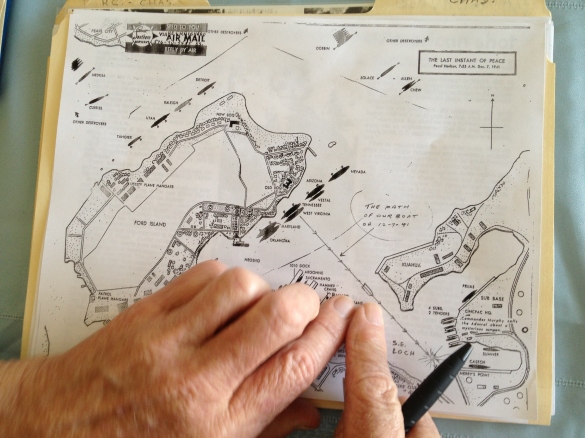
Richard Cunningham points to the location of his boat in Pearl Harbor.

“At 7:55 we’re right here and we’re facing these torpedo planes,” Cunningham said pointing at the spot on a map he had carefully written “the path of our boat on 12-7-41.”

“There was a big blast and we saw those two meatballs and we said to ourselves, ‘This is it! This is it. Those are Japanese and we’re at war. This is no training. This is no drill.’ ”

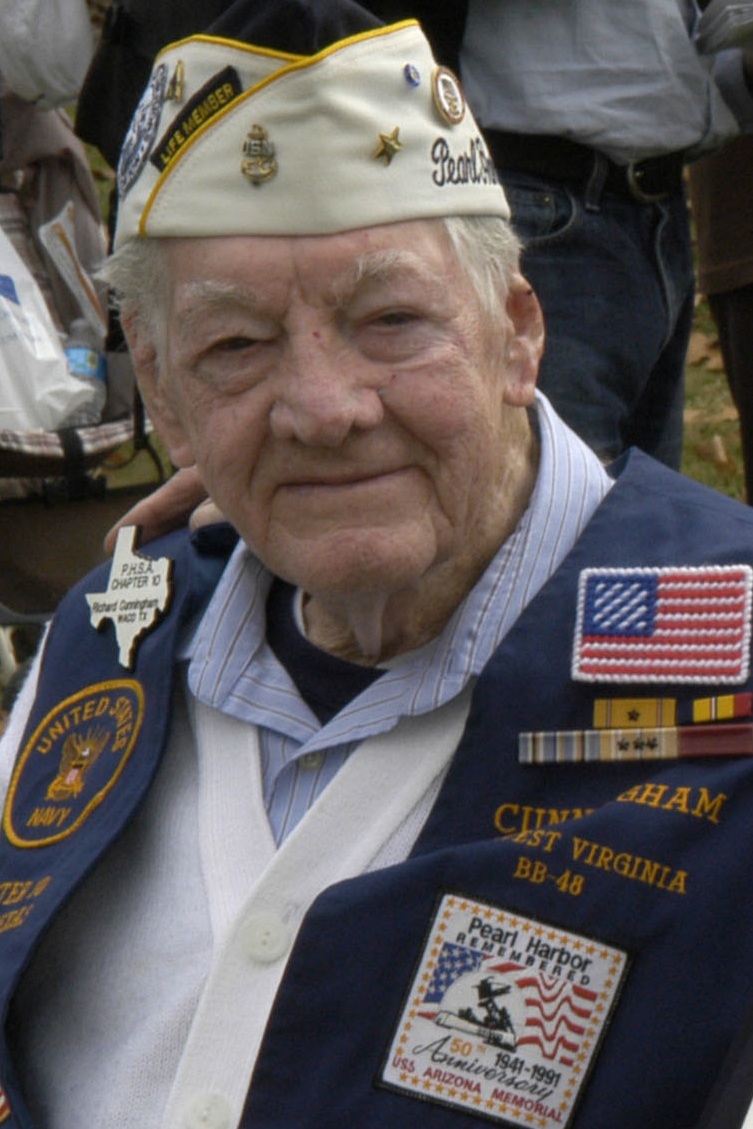
Seventy-one years after that day, the silver-haired Cunningham told his story while at the home in Hewitt, Texas he shares with Patty, his wife of twenty-nine years. He is among the few people still alive to witness firsthand the event that thrust the United States into World War II.

Cunningham is a retired aerospace industry employee who has spent most of his life in Texas. He grew up in Irondale, Ohio, the eldest of four. His father, a veteran of WWI, worked in a brickyard and the family lived in the back of a grocery store during the dark days of the Depression. Cunningham learned to fish and hunt rabbits and groundhogs.

“I grew up with a gun in my hand,” he said. “I kept my family in meat.” After graduating high school, one of Cunningham’s buddies, nicknamed Little Joe, pestered him to join the Navy.

“He asked me one time too many times.” He told Little Joe, “Let’s go!” Cunningham was attracted by a steady military paycheck. They enlisted in Youngstown. They trained at the Great Lakes Naval Station near Chicago and then went separate ways. Cunningham shipped off for duty on the 623-foot-long USS West Virginia, commissioned in 1923 and yet still the nation’s newest battleship. It was being refurbished at the naval shipyard in Bremerton, Washington. Cunningham’s first job was to scrape barnacles off the sides of the ship. In late 1940, it relocated to Pearl Harbor with the rest of the Pacific fleet.

001
Richard Cunningham at the 2012 Pearl Harbor commemoration at the National Museum of the Pacific War in Fredericksburg, Texas.

As with other WWII veterans, Cunningham is something of an amateur historian. Close at hand was a stack of a half dozen manila folders filled with war-related documents, photos, and maps, as well as war books, including one entitled Betrayal at Pearl Harbor: How Churchill Lured Roosevelt into World War II.

At age ninety-two, Cunningham retains a good memory. He has memorized more than four hundred gospel and bluegrass songs and plays the mandolin and guitar. The challenge in interviewing him was his hearing difficulties, and he often turned to his wife to relay questions. “Patty is my second ear,” he said.

He carefully laid on his kitchen table an aerial map of what Pearl Harbor looked like that morning, including the location of all the major ships and facilities. The West Virginia and six other battleships were anchored two-by-two at Ford Island, a 330-acre isle in the middle of Pearl Harbor used by the U.S. Navy to moor ships, for an airfield, barracks and other facilities. All around the harbor there was a mighty assortment of ships: another battleship, the USS Pennsylvania, was in dry-dock at the Navy Yard, plus nearly ninety others: destroyers, cruisers, tenders, survey ships.

Cunningham continued his story. “One after another, we’re facing these torpedo planes. You’d look up and see these guys, and they’re grinning from ear to ear. They had the machine gunner behind them. But the pilot of our boat, Earl Kuhn, he kept that boat right underneath these Japanese torpedo planes. The planes were dropping torpedos, which were running under and beside our boat. But he kept it there because had we cut and run I wouldn’t be talking to you now because the machine gunner would have got us. We’re right underneath and the machine gunner can’t shoot down.”

Alarms and general quarters announcements sounded, calling all sailors on ships, as well airmen at Hickman and other airfields, to battle stations. In four minutes, Cunningham witnessed one of the first American shots of the war. Two sailors on the USS Sumner, a survey ship moored at a nearby submarine base, fired its World War I-era guns. They hit one of planes point blank.

“There was a ball of fire so close that it singed my eyebrows and the hair on the back of my hands,” Cunningham said, wide-eyed, remembering the scene. “And the plane just disappeared. The ball of fire just melted it. And the propeller went spinning toward Kuahua [a peninsula that housed a new supply depot].”

The action report filed by the ship’s commanding officer following the attack corroborates Cunningham’s story:

0757 Signal watch and quartermaster on bridge sighted approximately 10 dive bombers, marked with red discs, attacking Navy Yard. …
0759 Went to general quarters. Observed torpedo planes approaching from S.E. over Southeast loch, attacking BB’s [battleships] at Ford Island Mooring Platform, circling Ford Island, and flying off to S.W. Red discs plainly visible on planes.
0801 … Gun crews opened fire immediately on manning guns without waiting to establish communication with control. … Sumner was first ship in vicinity to open fire. …
0803 Torpedo plane passed close aboard, within about 100 yards of Sumner’s stern, on W. course, altitude about 75 feet, leveled off for launching torpedo at BB’s. Plane continued on its course until it was about 300 yards distant from Sumner’s stern, wh[en] it was struck by a direct hit from Sumner’s No. 3 A.A. gun. Plane’s gasoline tank believed ignited, as plane immediately disintegrated in flames and sank in fragments. Torpedo believed sunk without exploding. …

Cunningham saw the eighteen-foot torpedo of the vaporized plane fall into the water. “It went straight down and then it came back up. It resurfaced. When the torpedo came back up it started going in an erratic fashion like this,” he said, holding out an arm and moving it back and forth. The torpedo locked onto their boat. Though the hull was made of wood, it had a metal motor, and it headed right for them. Japanese torpedoes were equipped with honing devices to fix onto metal objects.

“So the coxswain–old Kuhn–put the pedal to the medal. We went into the dock area near the officers’ club landing. Bill Morris was the bow hooker and he had his line in hand and I was the stern hook and I had my line in my hand and we both, we swear, we jumped six or seven feet to that landing. That was the fastest tie-up in history that day [laughs].” The three men ran up the landing and ducked behind a concrete abutment, hoping to avoid the explosion. “We made it and we thought there would be the big explosion when that torpedo hit that dock. But it didn’t happen.” They peeked up over the abutment to see that the torpedo had beached itself on a sandbar between the dock’s pilings.

004 (3)
Cunningham and his crew mates witnessed the attack from their boat in the middle of the harbor.

They looked across the harbor could see the whole thing, the whole attack, as enemy planes continued to pour in, fires raged, and smoked filled the air. “At 8:10 we saw the Arizona blow up. We saw the Oklahoma turning over, and found the West Virginia taking torpedo hits.”

They ran back to their boat and headed right back into the harbor, its water slick with oil and fire. As ships began to fall, hundreds—thousands—of men jumped or fell into the water. Cunningham and his men picked up “boat load after boat load” of them.

“We’d pick these guys up out of the water and we’d bring them to the submarine base. This is still the first attack.” They watched as men wrenched themselves from portholes barely 18 inches in diameter, their eyes wide and their faces frenzied as Cunningham and the others pulled them into their small ship.

“You wouldn’t believe how some of these guys would open the porthole and the water was rushing in and they pulled themselves up against that water, out the porthole, and came up to the surface,” he recounted. One man was so panicked, so frantic, that Cunningham hit him just to get him to settle down.

“He was like a mad man. I hit him with the fist. It might have been the wrong thing to do but [I had] to settle him down, and he did. He sat. He was no problem after that and we picked up some more men and put them in there with him. And then we got over and carried them over to the submarine base and let them out.”

In the first of Japan’s two waves, all the battleships took bomb and or torpedo hits. The USS Oklahoma turned over and sank. The USS Arizona was mortally wounded by an armor-piercing bomb that ignited the ship’s forward ammunition magazine and the resulting explosion and fire killed 1,177 crewmen, the greatest loss of life on any ship that day. The California, Maryland, Tennessee, Nevada, and Pennsylvania also suffered heavy damage.

Cunningham’s ship, the USS West Virginia, was hit by two armored-piercing bombs through her deck and five aircraft torpedoes in her port side. Heavily damaged by the ensuing explosions, and suffering from severe flooding below decks, the crew abandoned ship while the West Virginia slowly settled to the harbor’s shallow forty-five-foot bottom. Of the 1,541 men on the West Virginia, one hundred and thirty were killed and fifty-two wounded.

The second attack came about an hour later.

“The second attack was bombs mostly. We stayed out in the harbor. The thing is when these guys released these bombs they would take a pass at us with their machines guns. One of them knocked out a window in our boat. None of us three got hit. But of course the boat, had a couple bullets in it [(laughs].”

“We stayed out in the harbor getting these guys who were injured to the submarine base.  It’s a funny thing but you think about your buddies. You think about other guys and think how you can help somebody else. You don’t go someplace and hide. You get out there and you start looking for some guys you can help and that’s what we did.”

On December 16, Cunningham’s mother received a telegram from the Navy. Her son was lost and presumed dead. The telegram read:

The department extends to you its sincerest sympathy in your great loss. To prevent possible aid to our enemies please do not divulge the name of his ship or station. If remains are recovered they will be interred temporarily in the locality where death occurred and you will be notified accordingly. Rear Admiral C.W. Nimitz, chief of the Bureau of Navigation

It wasn’t until December 19 that the Navy sent another telegram with the news that he was a survivor. Cunningham said he wasn’t able to call to clear the mix up because phones were inoperable.

And, besides, he and his mates were busy with countless duties after the attack, helped put out fires and salvaged ammunition that divers brought up from sunken ships. Orphans as such, with their ship home unavailable, they slept on their boat and lived on peanut butter and crackers they had on board.

After helping put out the fire on the Arizona, the three men headed for what had been their home, the West Virginia.

Pearl Harbor has a mean depth of forty-five feet and battleships have a forty-foot draft. Despite being hit with seven torpedoes on its port side, the West Virginia gracefully sank to the bottom after two sailors opened valves to let water out on starboard side to counter the floodwaters pouring in the port side. This allowed the great ship, longer than two football fields, to settle in a somewhat level position.

Cunningham and his crew tied up alongside. They climbed aboard and waded knee-deep in the black, oily water across its deck. Cunningham found his locker. His belongings were all burned up, including his photo album and even the medals he won for besting other sailors in rowing and sailing competitions. Just one thing was not destroyed: the brooch. Just before Christmas, after being assigned a bunk in a barracks onshore, he mailed it to his mother.

Cunningham served the rest of the war helping to run supply and troop ships that sailed into battles across the Pacific, including Guadalcanal, the Treasury Islands, New Georgia, Rendova, and Bougainville. In one fight, he fired a machine gun at diving Japanese planes, his bare feet on the ship’s railings to avoid hot shell casings that littered the deck. Another night, near New Georgia, his ship struck a reef and all but sank. Some coral kept its bow out of the water and he and his shipmates huddled there and clung for life. They were rescued by a U.S. minesweeper the next day.

In March 1945, remarkably more than four years after he joined the Navy, Cunningham returned home for the first time since he shipped out, an occasion marked by a story in the local paper.

Cunningham's brooch is on display at the National Museum of the Pacific War in Fredericksburg, Texas.
Cunningham’s brooch.

After the war, he had a brief marriage and a long one and four daughters. He moved to Texas and worked in the aerospace industry. Among other things, he wrote and prepared engineering and performance documents on F-111 fighter jets for General Dynamics in Fort Worth. Nearly thirty years ago, he married a third time, to Patty, who also remembers WWII from the perspective of a schoolchild.

In 1993, two years after his mother’s death, Cunningham donated the brooch to the National Museum of the Pacific War in Fredericksburg where it is on display.