Richard Cunningham and December 7, 1941

Shortly after sunrise, Seaman 1st Class Richard Cunningham and two other sailors, Earl Kuhn and Bill Morris, boarded a wooden boat tethered to their battleship, the USS West Virginia. They got underway at 7:50 a.m. and motored across the placid water. Theirs was a most routine assignment that morning: cross the harbor to a dock near the officers’ club where several officers waited for a pick up.

Despite all the talk of an impending war, crews were not on high alert. December 7 was a Sunday and Sundays were leisurely. Sailors were at ease. Officers slept onshore. Some men nursed hangovers from a Saturday night in Honolulu, others gathered for Sunday morning services topside. Watertight hatches and doors on the big warships–compartments designed to confine damage and flooding to a small area in an attack–were open.

The day before, Cunningham took shore leave and shopped for a Christmas gift for his mother. He bought her a cameo brooch, which he stored in his locker beside his bunk on deck.

After a restful night’s sleep, Cunningham was dressed in his Navy whites and stood on the boat’s wooden deck to enjoy the cool breeze. Looking across the smooth water, he held onto the sparkling brass railing, shiny from the endless hours of polishing by Cunningham and the crew.

Suddenly, the calm was shattered by loud sounds and the sight of torpedo bombers swooping down directly overhead and skimming the water’s surface. Cunningham found himself with a front-row seat to one of history’s biggest events—the attack on Pearl Harbor.

Cunningham remembered looking up and recognizing the red discs on the sides of the Japanese torpedo bombers, discs sailors called big red meatballs.
007 (2)
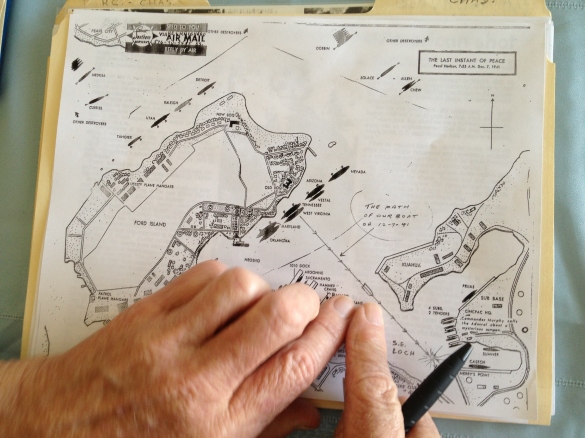
Richard Cunningham points to the location of his boat in Pearl Harbor.

“At 7:55 we’re right here and we’re facing these torpedo planes,” Cunningham said pointing at the spot on a map he had carefully written “the path of our boat on 12-7-41.”

“There was a big blast and we saw those two meatballs and we said to ourselves, ‘This is it! This is it. Those are Japanese and we’re at war. This is no training. This is no drill.’ ”

Seventy-one years after that day, the silver-haired Cunningham told his story while at the home in Hewitt, Texas he shares with Patty, his wife of twenty-nine years. He is among the few people still alive to witness firsthand the event that thrust the United States into World War II.

Cunningham is a retired aerospace industry employee who has spent most of his life in Texas. He grew up in Irondale, Ohio, the eldest of four. His father, a veteran of WWI, worked in a brickyard and the family lived in the back of a grocery store during the dark days of the Depression. Cunningham learned to fish and hunt rabbits and groundhogs.

“I grew up with a gun in my hand,” he said. “I kept my family in meat.” After graduating high school, one of Cunningham’s buddies, nicknamed Little Joe, pestered him to join the Navy.

“He asked me one time too many times.” He told Little Joe, “Let’s go!” Cunningham was attracted by a steady military paycheck. They enlisted in Youngstown. They trained at the Great Lakes Naval Station near Chicago and then went separate ways. Cunningham shipped off for duty on the 623-foot-long USS West Virginia, commissioned in 1923 and yet still the nation’s newest battleship. It was being refurbished at the naval shipyard in Bremerton, Washington. Cunningham’s first job was to scrape barnacles off the sides of the ship. In late 1940, it relocated to Pearl Harbor with the rest of the Pacific fleet.
001
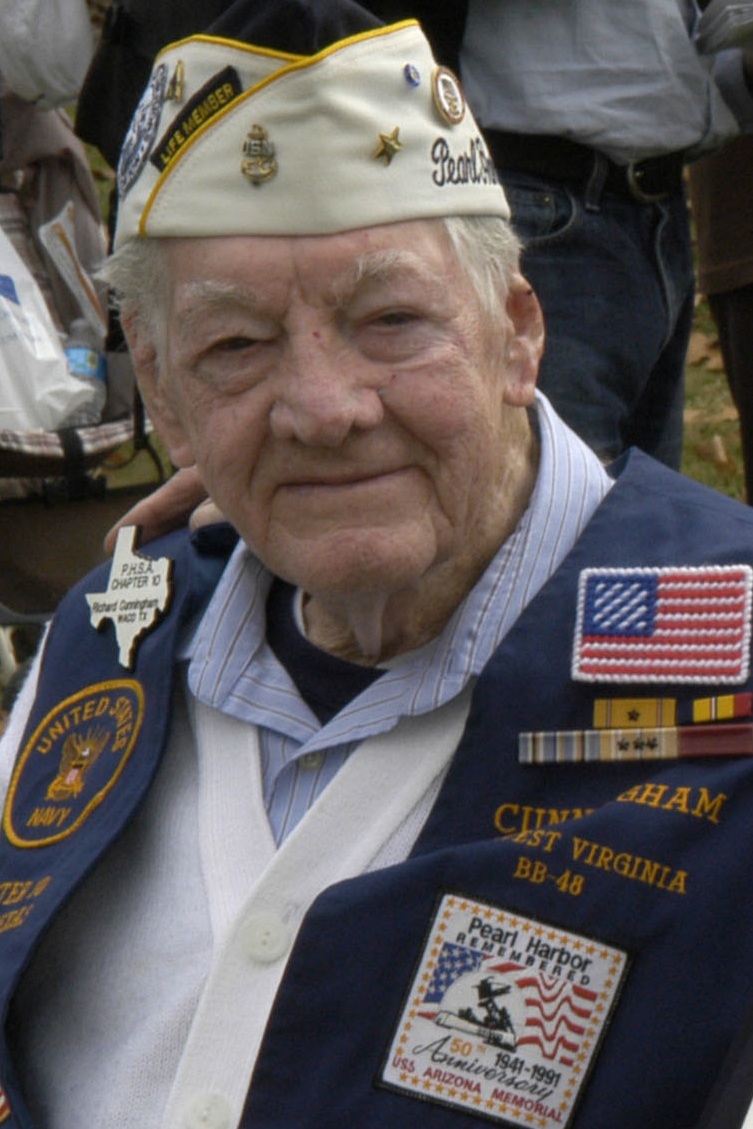
Richard Cunningham at the 2012 Pearl Harbor commemoration at the National Museum of the Pacific War in Fredericksburg, Texas.

As with other WWII veterans, Cunningham is something of an amateur historian. Close at hand was a stack of a half dozen manila folders filled with war-related documents, photos, and maps, as well as war books, including one entitled Betrayal at Pearl Harbor: How Churchill Lured Roosevelt into World War II.

At age ninety-two, Cunningham retains a good memory. He has memorized more than four hundred gospel and bluegrass songs and plays the mandolin and guitar. The challenge in interviewing him was his hearing difficulties, and he often turned to his wife to relay questions. “Patty is my second ear,” he said.

He carefully laid on his kitchen table an aerial map of what Pearl Harbor looked like that morning, including the location of all the major ships and facilities. The West Virginia and six other battleships were anchored two-by-two at Ford Island, a 330-acre isle in the middle of Pearl Harbor used by the U.S. Navy to moor ships, for an airfield, barracks and other facilities. All around the harbor there was a mighty assortment of ships: another battleship, the USS Pennsylvania, was in dry-dock at the Navy Yard, plus nearly ninety others: destroyers, cruisers, tenders, survey ships.

Cunningham continued his story. “One after another, we’re facing these torpedo planes. You’d look up and see these guys, and they’re grinning from ear to ear. They had the machine gunner behind them. But the pilot of our boat, Earl Kuhn, he kept that boat right underneath these Japanese torpedo planes. The planes were dropping torpedos, which were running under and beside our boat. But he kept it there because had we cut and run I wouldn’t be talking to you now because the machine gunner would have got us. We’re right underneath and the machine gunner can’t shoot down.”

Alarms and general quarters announcements sounded, calling all sailors on ships, as well airmen at Hickman and other airfields, to battle stations. In four minutes, Cunningham witnessed one of the first American shots of the war. Two sailors on the USS Sumner, a survey ship moored at a nearby submarine base, fired its World War I-era guns. They hit one of planes point blank.

“There was a ball of fire so close that it singed my eyebrows and the hair on the back of my hands,” Cunningham said, wide-eyed, remembering the scene. “And the plane just disappeared. The ball of fire just melted it. And the propeller went spinning toward Kuahua [a peninsula that housed a new supply depot].”

The action report filed by the ship’s commanding officer following the attack corroborates Cunningham’s story:

0757 Signal watch and quartermaster on bridge sighted approximately 10 dive bombers, marked with red discs, attacking Navy Yard. …
0759 Went to general quarters. Observed torpedo planes approaching from S.E. over Southeast loch, attacking BB’s [battleships] at Ford Island Mooring Platform, circling Ford Island, and flying off to S.W. Red discs plainly visible on planes.
0801 … Gun crews opened fire immediately on manning guns without waiting to establish communication with control. … Sumner was first ship in vicinity to open fire. …
0803 Torpedo plane passed close aboard, within about 100 yards of Sumner’s stern, on W. course, altitude about 75 feet, leveled off for launching torpedo at BB’s. Plane continued on its course until it was about 300 yards distant from Sumner’s stern, wh[en] it was struck by a direct hit from Sumner’s No. 3 A.A. gun. Plane’s gasoline tank believed ignited, as plane immediately disintegrated in flames and sank in fragments. Torpedo believed sunk without exploding. …

Cunningham saw the eighteen-foot torpedo of the vaporized plane fall into the water. “It went straight down and then it came back up. It resurfaced. When the torpedo came back up it started going in an erratic fashion like this,” he said, holding out an arm and moving it back and forth. The torpedo locked onto their boat. Though the hull was made of wood, it had a metal motor, and it headed right for them. Japanese torpedoes were equipped with honing devices to fix onto metal objects.

“So the coxswain–old Kuhn–put the pedal to the medal. We went into the dock area near the officers’ club landing. Bill Morris was the bow hooker and he had his line in hand and I was the stern hook and I had my line in my hand and we both, we swear, we jumped six or seven feet to that landing. That was the fastest tie-up in history that day [laughs].” The three men ran up the landing and ducked behind a concrete abutment, hoping to avoid the explosion. “We made it and we thought there would be the big explosion when that torpedo hit that dock. But it didn’t happen.” They peeked up over the abutment to see that the torpedo had beached itself on a sandbar between the dock’s pilings.

004 (3)
Cunningham and his crew mates witnessed the attack from their boat in the middle of the harbor.

They looked across the harbor could see the whole thing, the whole attack, as enemy planes continued to pour in, fires raged, and smoked filled the air. “At 8:10 we saw the Arizona blow up. We saw the Oklahoma turning over, and found the West Virginia taking torpedo hits.”

They ran back to their boat and headed right back into the harbor, its water slick with oil and fire. As ships began to fall, hundreds—thousands—of men jumped or fell into the water. Cunningham and his men picked up “boat load after boat load” of them.

“We’d pick these guys up out of the water and we’d bring them to the submarine base. This is still the first attack.” They watched as men wrenched themselves from portholes barely 18 inches in diameter, their eyes wide and their faces frenzied as Cunningham and the others pulled them into their small ship.

“You wouldn’t believe how some of these guys would open the porthole and the water was rushing in and they pulled themselves up against that water, out the porthole, and came up to the surface,” he recounted. One man was so panicked, so frantic, that Cunningham hit him just to get him to settle down.

“He was like a mad man. I hit him with the fist. It might have been the wrong thing to do but [I had] to settle him down, and he did. He sat. He was no problem after that and we picked up some more men and put them in there with him. And then we got over and carried them over to the submarine base and let them out.”

In the first of Japan’s two waves, all the battleships took bomb and or torpedo hits. The USS Oklahoma turned over and sank. The USS Arizona was mortally wounded by an armor-piercing bomb that ignited the ship’s forward ammunition magazine and the resulting explosion and fire killed 1,177 crewmen, the greatest loss of life on any ship that day. The California, Maryland, Tennessee, Nevada, and Pennsylvania also suffered heavy damage.

Cunningham’s ship, the USS West Virginia, was hit by two armored-piercing bombs through her deck and five aircraft torpedoes in her port side. Heavily damaged by the ensuing explosions, and suffering from severe flooding below decks, the crew abandoned ship while the West Virginia slowly settled to the harbor’s shallow forty-five-foot bottom. Of the 1,541 men on the West Virginia, one hundred and thirty were killed and fifty-two wounded.

The second attack came about an hour later.

“The second attack was bombs mostly. We stayed out in the harbor. The thing is when these guys released these bombs they would take a pass at us with their machines guns. One of them knocked out a window in our boat. None of us three got hit. But of course the boat, had a couple bullets in it [(laughs].”

“We stayed out in the harbor getting these guys who were injured to the submarine base.  It’s a funny thing but you think about your buddies. You think about other guys and think how you can help somebody else. You don’t go someplace and hide. You get out there and you start looking for some guys you can help and that’s what we did.”

On December 16, Cunningham’s mother received a telegram from the Navy. Her son was lost and presumed dead. The telegram read:

The department extends to you its sincerest sympathy in your great loss. To prevent possible aid to our enemies please do not divulge the name of his ship or station. If remains are recovered they will be interred temporarily in the locality where death occurred and you will be notified accordingly. Rear Admiral C.W. Nimitz, chief of the Bureau of Navigation

It wasn’t until December 19 that the Navy sent another telegram with the news that he was a survivor. Cunningham said he wasn’t able to call to clear the mix up because phones were inoperable.

And, besides, he and his mates were busy with countless duties after the attack, helped put out fires and salvaged ammunition that divers brought up from sunken ships. Orphans as such, with their ship home unavailable, they slept on their boat and lived on peanut butter and crackers they had on board.

After helping put out the fire on the Arizona, the three men headed for what had been their home, the West Virginia.

Pearl Harbor has a mean depth of forty-five feet and battleships have a forty-foot draft. Despite being hit with seven torpedoes on its port side, the West Virginia gracefully sank to the bottom after two sailors opened valves to let water out on starboard side to counter the floodwaters pouring in the port side. This allowed the great ship, longer than two football fields, to settle in a somewhat level position.

Cunningham and his crew tied up alongside. They climbed aboard and waded knee-deep in the black, oily water across its deck. Cunningham found his locker. His belongings were all burned up, including his photo album and even the medals he won for besting other sailors in rowing and sailing competitions. Just one thing was not destroyed: the brooch. Just before Christmas, after being assigned a bunk in a barracks onshore, he mailed it to his mother.

Cunningham served the rest of the war helping to run supply and troop ships that sailed into battles across the Pacific, including Guadalcanal, the Treasury Islands, New Georgia, Rendova, and Bougainville. In one fight, he fired a machine gun at diving Japanese planes, his bare feet on the ship’s railings to avoid hot shell casings that littered the deck. Another night, near New Georgia, his ship struck a reef and all but sank. Some coral kept its bow out of the water and he and his shipmates huddled there and clung for life. They were rescued by a U.S. minesweeper the next day.

In March 1945, remarkably more than four years after he joined the Navy, Cunningham returned home for the first time since he shipped out, an occasion marked by a story in the local paper.

Cunningham's brooch is on display at the National Museum of the Pacific War in Fredericksburg, Texas.
Cunningham’s brooch.

After the war, he had a brief marriage and a long one and four daughters. He moved to Texas and worked in the aerospace industry. Among other things, he wrote and prepared engineering and performance documents on F-111 fighter jets for General Dynamics in Fort Worth. Nearly thirty years ago, he married a third time, to Patty, who also remembers WWII from the perspective of a schoolchild.

In 1993, two years after his mother’s death, Cunningham donated the brooch to the National Museum of the Pacific War in Fredericksburg where it is on display.

Visiting a WWII stalag in a small Texas town

Heino Erichsen
Heino was an eighteen-year-old German infrantryman when this photo was taken in 1942.

Heino Erichsen was born June 7, 1924 in Kiel, Germany, a Baltic Sea port. When he was nine years old, Adolph Hitler became Germany’s chancellor and led the country into its irrational and destructive decade that led to perhaps the world’s largest and most gruesome war and ethnic persecution.

When he was growing up, Heino was among many thousands of German boys who became members of Hitler Youth, a compulsory military indoctrination program of the the German war machine. In May 1943, a month away from his eighteenth birthday, Heino was drafted into the German Army and sent to boot camp in Denmark, where he trained to fire machine guns, and within months he was a member of the German Afrika Korps sent to North Africa to fight a losing battle against the Allied forces. He was taken as a prisoner and shipped with hundreds of thousands of German prisoners to newly built POW camps in the United States. After arriving in New York and deloused, Heino was put on a train to Hearne, a little town in East Central Texas.

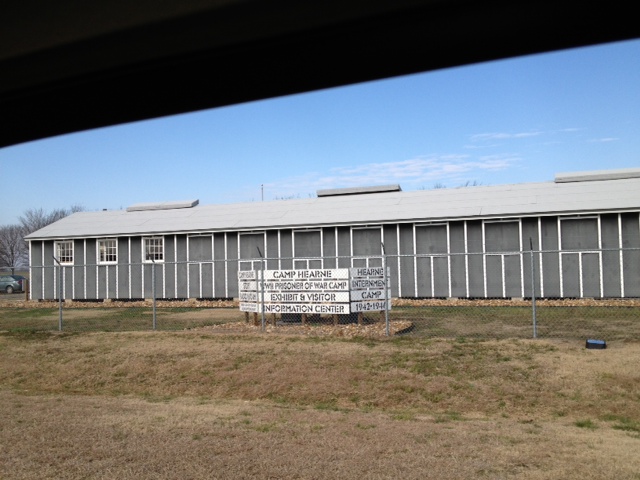
Heino was among as many as 4,800 German POWs who lived at Camp Hearne, where the government built 250 buildings: barracks, hospital buildings, guard towers, administrative facilities, mess halls and a building that prisoners converted into a 200-seat theater. The barbed wire that fenced in the POWs would line 1,800 miles, more than enough to stretch to Chicago.

Camp Hearne POW camp now houses a museum.

Hearne city boosters had successfully lobbied the War Department to build the camp just outside of town as a way to bolster the local economy. It was among the largest of dozens of facilities in Texas that housed POWs during World War II.

Most of the German POWs at Hearne were noncommissioned officers, hard-liner sergeant types who were strong believers in the Third Reich. “We had some scary guys,” Melissa Freemen told me Friday during a tour of the Camp Hearne Exhibit and Visitors Center.

From all indications, Heino was not among the scaries. This morning I met Heino at the independent living facility he lives in The Woodlands, a little more than an hour’s drive from Hearne. He greeted me with a smile and lightly touched my arm as he shook my hand. His demeanor is of a kindly, gentle man in a cardigan sweater.

Speaking in a s German accent, Heino recalled that he spent most of his days as a prisoner working in local farms, shearing sheep, working with cows and plowing fields.

Heino was a lowly private in the German infantry, and was compelled to labor in the fields. But the German officers in the camp, roughly eighty percent of the prisoners, were not required to work, which is a provision of the Geneva Convention, the international agreement that governs the treatment of war prisoners to which the United States abided. The officers spent much of their days in recreation, playing soccer, going to classes, staging plays, crafting artwork and woodworking projects, and building gardens and water fountains to beautify the 700-plus acre site.

After the war, Heino went back to his hometown in Germany, and lucked into a cushy job: as a translator for a British government official who managed two German counties. But he never forgot Texas. In 1953 he emigrated to the United States with his young German bride and their son. He worked as an accountant at a hospital in Minnesota, and eventually divorced and became a single parent to his son. He met Jean, a Minnesota native and also a single parent, and they married in 1962. They both earned master’s degrees (his in business, hers in counseling). They adopted three children from Colombia and moved to Austin, where in 1981 they launched what the Erichsens say became the state’s first international adoption agency, Los Ninos.

Three years ago, after placing 3,000 orphans from 20 countries into new homes, the Erichsens retired and closed the agency and they now live outside of Houston.

These days, Heino is a celebrity of sorts at the Hearne camp, where he frequently visits to speak about his life and his experiences. “I’m the only former prisoner who came back and became a U.S. citizen and live in Texas,” Heino said. He co-authored a book about his life, “The Reluctant Warrior: Former German POW Finds Peace Texas.”

Nearly seventy years after the end of WWII, Camp Hearne is a shadow of its former self. The only original structures that remain are a water pump house and a small structure for a water well (both were renovated with a brick facade by the city long ago). The museum maintains eleven acres, where there is a newly built barrack that houses displays of artifact, photos and exhibits showing how the POWs lived and worked. Outside, is recently completed a guard tower.

Across the road from the museum, I walked about one-third of a mile down a path that long ago went down the middle of one of the three POW camp compounds. You can make out numerous concrete foundations on both sides that seem to want to be taken over by the scruffy underbrush, weeds and mesquite. You have to use your imagination to see thousands of German prisoners, dressed in Army fatigues with “POW” stamped on the back and wearing shorts during the hot summer months. Some sit on stoops, eyeing visitors walking this way, while others go about their activities, perhaps kicking a soccer ball or telling a story in German.

Kneeling Lady Foundation
The Kneeling Lady Foundation built by German POWs once had an elegant kneeling woman holding a platter. Three frogs positioned on the edge of the fountain sprayed water onto the platter.

At the end of the path, in a small circular clearing, there is the remnants of the Kneeling Lady Fountain, an elaborate construction that once featured a kneeling woman on a pedestal holding a platter. A photo in the museum shows an artistic creation, a Greek-like woman in the middle of a pool, with three cement frogs that spouted water onto the platter she held. An exhibit case in the museum holds portions of the frogs. If you try, you may very well hear trickling water and the spray from the frogs.

Features such as this were uncovered by Mike Waters, a Texas A&M anthropology professor who has explored the site and wrote a book about the camp, “Lone Star Stalag.” His work helped inspire Cathy Lazarus, a retired pharmacist who led the creation of Roll Call, Friends of Camp Hearne, the nonprofit organization that opened in the museum in 2011 with community support. The museum preserves the history of the POW camp. It is well worth the trip, especially if Freemen and Lazarus provide you a personal tour. Learn more about the museum on its website.

One of the last of the Raiders: Lt. Col. Richard “Dick” Cole

Image

I pull up to the gate and I see the old man out front of his brick home. I drive in and park next to a pickup truck. As I get out of my car, roosters squawk and three buffalos chomp faded grass out back and the smell of large animals fill the December air.

I’m a little anxious as I walk up to greet him. I’m running behind schedule. It’s after 11 a.m. and I was supposed to be here at 10:30 a.m.

“I’m sorry I’m late,” I bellow to announce my presence. He doesn’t hear me. His back is turned and he is holding a plastic container and spraying weeds. I knew hearing was hard for him and now I understand he is really hard of hearing.

He turns to face my way.

“You’re not any more organized than I am,” Lt. Col. Richard “Dick” Cole says. I apologize and explain I got lost trying to find his home on the back roads of the Texas Hill Country.

I witness for the first time his open-mouth smile that exudes enormous warmth and I see his blue eyes shining.

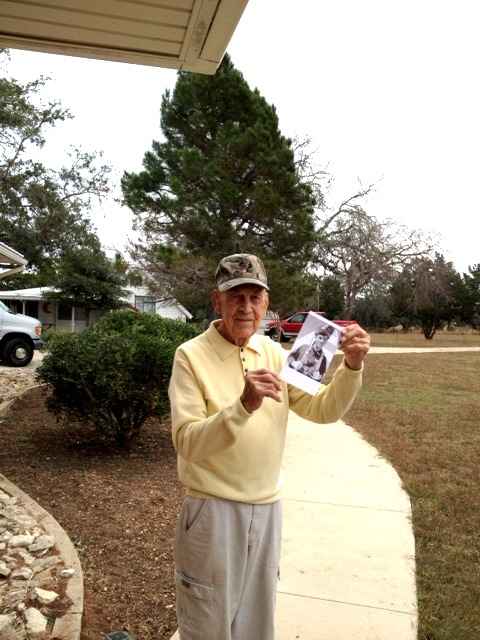
He welcomes us inside and we enter a living room with comfortable furniture that I learn later Dick made himself. Not a light is on. I’m with photographer E. Joe Deering. E. Joe asks whether Dick has any photos from the war. Dick fishes one from an old file, a black and white that shows Dick in his mid-20s, wearing a flight suit. He is standing with his hands grasping the straps of a parachute and in the background I can see the tail of a plane. We go outside and E. Joe takes photos of Dick holding the photo of a time long ago, when this flyboy was among 80 men who carried out one of the most daring missions in the early months of World War II.

Dick was a pilot on a crew that would become known to history as Doolittle’s Raiders, men who in April 1942 flew modified B-25 bombers to drop explosives on Tokyo. Unless you are a World War II geek, you may not have heard about this mission, which was designed to give Japan a shock and provide a lift to the United States, whose citizens were still demoralized by Japan’s attack on Pearl Harbor.

Dick, 97, is one of only five of men who can speak firsthand about the mission. All the others have flown west, parlance for airmen who have died.

Postscript: Dick died on April 9, 2019 at age 103. https://www.airforcetimes.com/news/your-air-force/2019/04/09/a-legend-passes-dick-cole-last-of-the-doolittle-raiders-dies-at-103/

Survivors of the Attack on Pearl Harbor

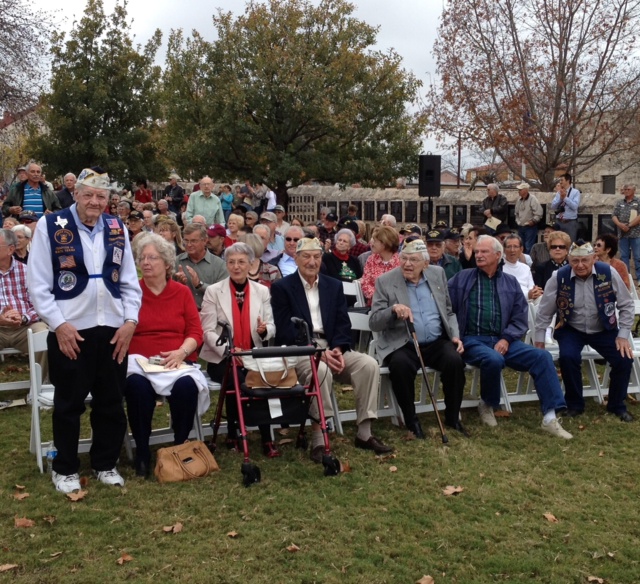
Below is a photo of four survivors who attended a ceremony to commemorate the attack on Pearl Harbor. The gentlemen — all gracious and generous and kind men — are wearing tan caps. Left to right stands Richard Cunningham of Hewitt, Texas, and then sitting: Vernon Kelly of Mesquite, Texas, Robert Brunk of Kerrville, Texas, and  J.C. Alston from Troy, Texas. (I send a shout out to Helen McDonald, manager of events at the National Museum of the Pacific War. She organizes the annual event and has been invaluable in helping me to contact WWII veterans.)

photo of four survivors

Dec. 7, 1941 circa 2012

Vernon Kelly of Mesquite, Texas, was on the USS Honolulu when the Japanese bombed Pearl Harbor.
Vernon Kelly of Mesquite, Texas, was on the USS Honolulu when the Japanese bombed Pearl Harbor and then served on two other ships during World War II. 

It was Sunday morning, about 10 minutes before 8 o’clock, seventy-one years ago. U.S. warships were tied up in the port of Honolulu. Vernon Kelly was aboard the USS Honolulu, a light cruiser. He was reading the comics in the newspaper. Katzenjammer Kids was his favorite.

Richard Cunningham had just left the battleship USS West Virginia in a small boat, and he was puttering across the harbor, ferrying some officers to the mainland.

J.C. Alston was on watch on the deck of the USS California, one of eight battleships lined up in battleship row. He waited for his relief so he could get some breakfast. That’s when he heard a plane overead. “I thought some aircraft carriers were training.” But a first class boatsmate who had served in the Asiatic region knew better. “Japanese planes!” Alston heard a tremendous explosion. “I guess that’s when the Arizona blew up.”

The story of the day of infamy has been told a gazillion times. The Japanese launched a sneak attack by sending some 350 bombers and fighter airplanes from six aircraft carriers to decimate the U.S. Pacific Fleet, killing 2,930 U.S. military personnel and 49 civilians. The next day, President Franklin D. Roosevelt declared war on the Empire of Japan and things were never the same. On Dec. 11, after Germany and Italy declared war on the United States, America was drawn into the biggest and most costly war the world has ever known.

Today, I was one of hundreds of people who attended the annual Pearl Harbor commemoration ceremony at the National Museum of the Pacific War in Fredericksburg, Texas. U.S. Marine Corps Gen. (retired) Mike Hagee spoke about the sacrifices of the Pearl Harbor survivors who attended, all sitting in VIP, front-row seats: Kelly, 90, Cunningham, 91, Alston, 89, and Robert Brunk, 90, a junior corpsman on the USS Curtiss, a seaplane tender.

After the ceremony, people crowded around the four men and waited to shake their hands. In some ways, it felt like big family reunion. Many people told about how their fathers, now deceased, were on this or that ship or served in this or that branch.

“Do you feel like a rock star?” I asked Brunk as people lined up to talk to him. He laughed. “He’s a hero,” a woman said.

Cunningham, a regular at this event, was asked to sign a book. He said he had media interviews lined up over the weekend, including with a Honolulu TV station. “None of my hats fit any more. My head’s getting too big,” he said with a laugh. He was accompanied by his wife and three of his four grown daughters, two of whom had never attended the Pearl Harbor observances.

Despite the good cheer, I felt like I was witnessing the last hurrah.These four men are among the fast-declining number of World War II veterans, most of whom are pushing 90 years or more. On Dec. 31, 2011, the Pearl Harbor Survivors Association dissolved because of the declining number and health of its members. The Veterans Administration estimates 760 U.S. World War II vets die every day.

Kelly, a retired lawyer from Mesquite, traveled with two companions, his wife, Ann, and his family physician, Ivette Lozano. When I inquired about his health, I was told he is suffering from lymphoma. But otherwise he is pretty healthy. He swims 17 laps a day in a swimming pool, I was told. “Sixteen,” Kelly corrected.

On this Friday morning, it wasn’t always easy to tell what happened seventy-one years ago, what with the swirl of speeches, conversations and well wishing going on in the museum’s memorial courtyard.

Like most anyone his age, Kelly’s memory isn’t as sharp as it was once. I gently probed for some details, both large and small. The comic pages he was reading, were they from the Honolulu newspaper? I wasn’t sure he understood the question. Oh, did I hear that right, he was injured? What? I repeated the question. He didn’t understand. I spoke louder. No, no, no he wasn’t. Was he below deck when the bombs hit? Or was he on the top deck? “I think he’s confused,” I heard Sue say quietly to Dr. Lozano. Did the bomb explode? Oh,  it was a dud. Later, I learned that the Honolulu was lucky: It suffered only minor hull damage from a near miss.

Kelly, who enlisted at age 19, served four years in the Navy and had the unusual distinction of crossing from the Pacific to the other side of the war, to the Atlantic, to serve on the SC -717, which he said was a sub chaser that hunted German U-boats. Then he was shipped back to the Pacific and served on the USS Tolland, an attack cargo ship that was on hand when the Japanese signed the terms of surrender with Gen. Douglas MacArthur aboard the USS Missouri on Sept. 2, 1945. While Kelly said everybody wants to ask about his experience at Pearl Harbor, he seemed to more want to talk about his other experiences. “I was on three different ships. It seems they are only interested in the Honolulu.”

He told me a story of how soon after Japan’s formal surrender, he took leave and by himself strolled the streets of Yokohama. He ended up at the Imperial Palace and stepped inside. I imagined some elaborate structure with impressive grounds. I wondered how lax security may have been at the time even at official buildings and even at war’s end. He said suddenly dozens of Japanese soldiers appeared, all carrying rifles. He felt their eyes on him and sensed danger and confusion. They spoke in Japanese. While the war was officially over, Kelly felt afraid. Would these soldiers, ashamed of losing, abide by the surrender? While he said some soldiers dropped their heads in shame, others eyed him and he heard sharp words. He slowly stepped away and went outside and wondered whether he might be shot in the back, though he imagined an international scandal would result. He made it safely back to his ship. Within a few months the Navy discharged him, he went to law school, he got married, had children, was divorced and, 46 years ago, he and Ann married.

Echoing something her husband often has said, Ann told me: “He had so many chances to die and he flubbed them all.”

***

Today is the first day of a month-long series of trips I am taking to research a book about Texas and Texans during World War II. Tomorrow I am scheduled to interview one of the last of Doolittle’s Raiders, Air Force Lt. Col. (ret.) Richard Cole, 97, who lives outside Comfort. Before I started this project I had only the vaguest notion of what Doolittle’s Raiders was. I still don’t know much, except that it was a group of 80 airmen who carried out a dangerous mission to bomb Tokyo in the early months of the war. I hear that Cole has quite a story.