Martha was bold: She snuck on a test flight Lt. Dick Cole piloted during World War II. Then Martha initiated a date with Dick. He was flabbergasted. She was beautiful and he thought she was too good for him. They wed two weeks later and were married for nearly 60 years until Martha died in 2003. This video was taken Dec. 8, 2012 at Cole’s home near Comfort, Texas. Cole, 97 years old, is one of only five members of Doolittle’s Raiders still alive.
I pull up to the gate and I see the old man out front of his brick home. I drive in and park next to a pickup truck. As I get out of my car, roosters squawk and three buffalos chomp faded grass out back and the smell of large animals fill the December air.
I’m a little anxious as I walk up to greet him. I’m running behind schedule. It’s after 11 a.m. and I was supposed to be here at 10:30 a.m.
“I’m sorry I’m late,” I bellow to announce my presence. He doesn’t hear me. His back is turned and he is holding a plastic container and spraying weeds. I knew hearing was hard for him and now I understand he is really hard of hearing.
He turns to face my way.
“You’re not any more organized than I am,” Lt. Col. Richard “Dick” Cole says. I apologize and explain I got lost trying to find his home on the back roads of the Texas Hill Country.
I witness for the first time his open-mouth smile that exudes enormous warmth and I see his blue eyes shining.
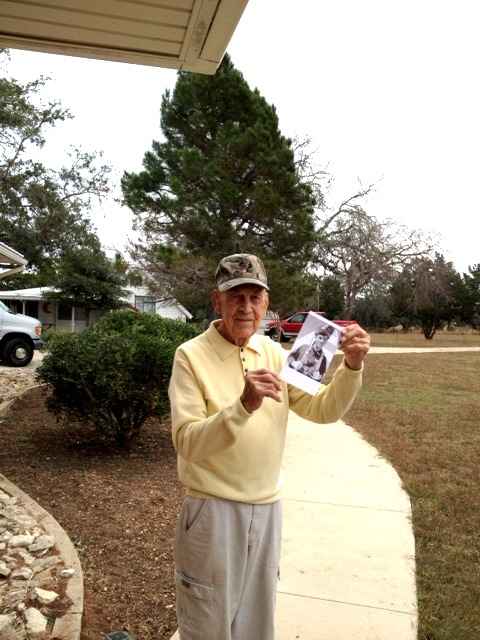
He welcomes us inside and we enter a living room with comfortable furniture that I learn later Dick made himself. Not a light is on. I’m with photographer E. Joe Deering. E. Joe asks whether Dick has any photos from the war. Dick fishes one from an old file, a black and white that shows Dick in his mid-20s, wearing a flight suit. He is standing with his hands grasping the straps of a parachute and in the background I can see the tail of a plane. We go outside and E. Joe takes photos of Dick holding the photo of a time long ago, when this flyboy was among 80 men who carried out one of the most daring missions in the early months of World War II.
Dick was a pilot on a crew that would become known to history as Doolittle’s Raiders, men who in April 1942 flew modified B-25 bombers to drop explosives on Tokyo. Unless you are a World War II geek, you may not have heard about this mission, which was designed to give Japan a shock and provide a lift to the United States, whose citizens were still demoralized by Japan’s attack on Pearl Harbor.
Dick, 97, is one of only five of men who can speak firsthand about the mission. All the others have flown west, parlance for airmen who have died.
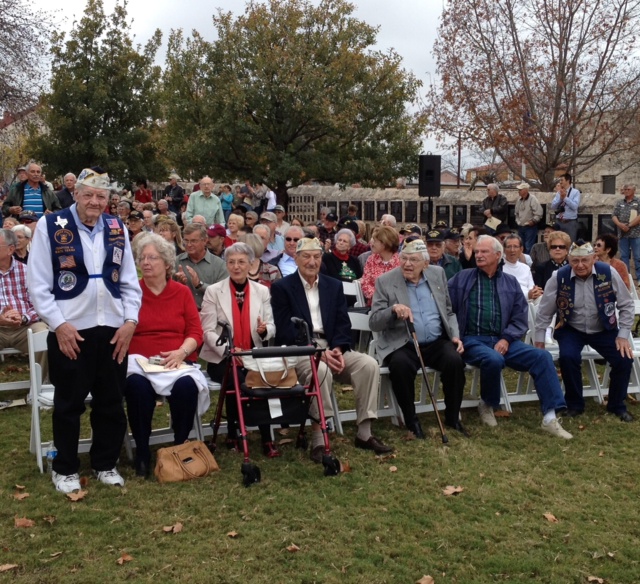
Below is a photo of four survivors who attended a ceremony to commemorate the attack on Pearl Harbor. The gentlemen — all gracious and generous and kind men — are wearing tan caps. Left to right stands Richard Cunningham of Hewitt, Texas, and then sitting: Vernon Kelly of Mesquite, Texas, Robert Brunk of Kerrville, Texas, and J.C. Alston from Troy, Texas. (I send a shout out to Helen McDonald, manager of events at the National Museum of the Pacific War. She organizes the annual event and has been invaluable in helping me to contact WWII veterans.)
Vernon Kelly of Mesquite, Texas, was on the USS Honolulu when the Japanese bombed Pearl Harbor and then served on two other ships during World War II.
It was Sunday morning, about 10 minutes before 8 o’clock, seventy-one years ago. U.S. warships were tied up in the port of Honolulu. Vernon Kelly was aboard the USS Honolulu, a light cruiser. He was reading the comics in the newspaper. Katzenjammer Kids was his favorite.
Richard Cunningham had just left the battleship USS West Virginia in a small boat, and he was puttering across the harbor, ferrying some officers to the mainland.
J.C. Alston was on watch on the deck of the USS California, one of eight battleships lined up in battleship row. He waited for his relief so he could get some breakfast. That’s when he heard a plane overead. “I thought some aircraft carriers were training.” But a first class boatsmate who had served in the Asiatic region knew better. “Japanese planes!” Alston heard a tremendous explosion. “I guess that’s when the Arizona blew up.”
The story of the day of infamy has been told a gazillion times. The Japanese launched a sneak attack by sending some 350 bombers and fighter airplanes from six aircraft carriers to decimate the U.S. Pacific Fleet, killing 2,930 U.S. military personnel and 49 civilians. The next day, President Franklin D. Roosevelt declared war on the Empire of Japan and things were never the same. On Dec. 11, after Germany and Italy declared war on the United States, America was drawn into the biggest and most costly war the world has ever known.
Today, I was one of hundreds of people who attended the annual Pearl Harbor commemoration ceremony at the National Museum of the Pacific War in Fredericksburg, Texas. U.S. Marine Corps Gen. (retired) Mike Hagee spoke about the sacrifices of the Pearl Harbor survivors who attended, all sitting in VIP, front-row seats: Kelly, 90, Cunningham, 91, Alston, 89, and Robert Brunk, 90, a junior corpsman on the USS Curtiss, a seaplane tender.
After the ceremony, people crowded around the four men and waited to shake their hands. In some ways, it felt like big family reunion. Many people told about how their fathers, now deceased, were on this or that ship or served in this or that branch.
“Do you feel like a rock star?” I asked Brunk as people lined up to talk to him. He laughed. “He’s a hero,” a woman said.
Cunningham, a regular at this event, was asked to sign a book. He said he had media interviews lined up over the weekend, including with a Honolulu TV station. “None of my hats fit any more. My head’s getting too big,” he said with a laugh. He was accompanied by his wife and three of his four grown daughters, two of whom had never attended the Pearl Harbor observances.
Despite the good cheer, I felt like I was witnessing the last hurrah.These four men are among the fast-declining number of World War II veterans, most of whom are pushing 90 years or more. On Dec. 31, 2011, the Pearl Harbor Survivors Association dissolved because of the declining number and health of its members. The Veterans Administration estimates 760 U.S. World War II vets die every day.
Kelly, a retired lawyer from Mesquite, traveled with two companions, his wife, Ann, and his family physician, Ivette Lozano. When I inquired about his health, I was told he is suffering from lymphoma. But otherwise he is pretty healthy. He swims 17 laps a day in a swimming pool, I was told. “Sixteen,” Kelly corrected.
On this Friday morning, it wasn’t always easy to tell what happened seventy-one years ago, what with the swirl of speeches, conversations and well wishing going on in the museum’s memorial courtyard.
Like most anyone his age, Kelly’s memory isn’t as sharp as it was once. I gently probed for some details, both large and small. The comic pages he was reading, were they from the Honolulu newspaper? I wasn’t sure he understood the question. Oh, did I hear that right, he was injured? What? I repeated the question. He didn’t understand. I spoke louder. No, no, no he wasn’t. Was he below deck when the bombs hit? Or was he on the top deck? “I think he’s confused,” I heard Sue say quietly to Dr. Lozano. Did the bomb explode? Oh, it was a dud. Later, I learned that the Honolulu was lucky: It suffered only minor hull damage from a near miss.
Kelly, who enlisted at age 19, served four years in the Navy and had the unusual distinction of crossing from the Pacific to the other side of the war, to the Atlantic, to serve on the SC -717, which he said was a sub chaser that hunted German U-boats. Then he was shipped back to the Pacific and served on the USS Tolland, an attack cargo ship that was on hand when the Japanese signed the terms of surrender with Gen. Douglas MacArthur aboard the USS Missouri on Sept. 2, 1945. While Kelly said everybody wants to ask about his experience at Pearl Harbor, he seemed to more want to talk about his other experiences. “I was on three different ships. It seems they are only interested in the Honolulu.”
He told me a story of how soon after Japan’s formal surrender, he took leave and by himself strolled the streets of Yokohama. He ended up at the Imperial Palace and stepped inside. I imagined some elaborate structure with impressive grounds. I wondered how lax security may have been at the time even at official buildings and even at war’s end. He said suddenly dozens of Japanese soldiers appeared, all carrying rifles. He felt their eyes on him and sensed danger and confusion. They spoke in Japanese. While the war was officially over, Kelly felt afraid. Would these soldiers, ashamed of losing, abide by the surrender? While he said some soldiers dropped their heads in shame, others eyed him and he heard sharp words. He slowly stepped away and went outside and wondered whether he might be shot in the back, though he imagined an international scandal would result. He made it safely back to his ship. Within a few months the Navy discharged him, he went to law school, he got married, had children, was divorced and, 46 years ago, he and Ann married.
Echoing something her husband often has said, Ann told me: “He had so many chances to die and he flubbed them all.”
***
Today is the first day of a month-long series of trips I am taking to research a book about Texas and Texans during World War II. Tomorrow I am scheduled to interview one of the last of Doolittle’s Raiders, Air Force Lt. Col. (ret.) Richard Cole, 97, who lives outside Comfort. Before I started this project I had only the vaguest notion of what Doolittle’s Raiders was. I still don’t know much, except that it was a group of 80 airmen who carried out a dangerous mission to bomb Tokyo in the early months of the war. I hear that Cole has quite a story.

 Charles Boisseau