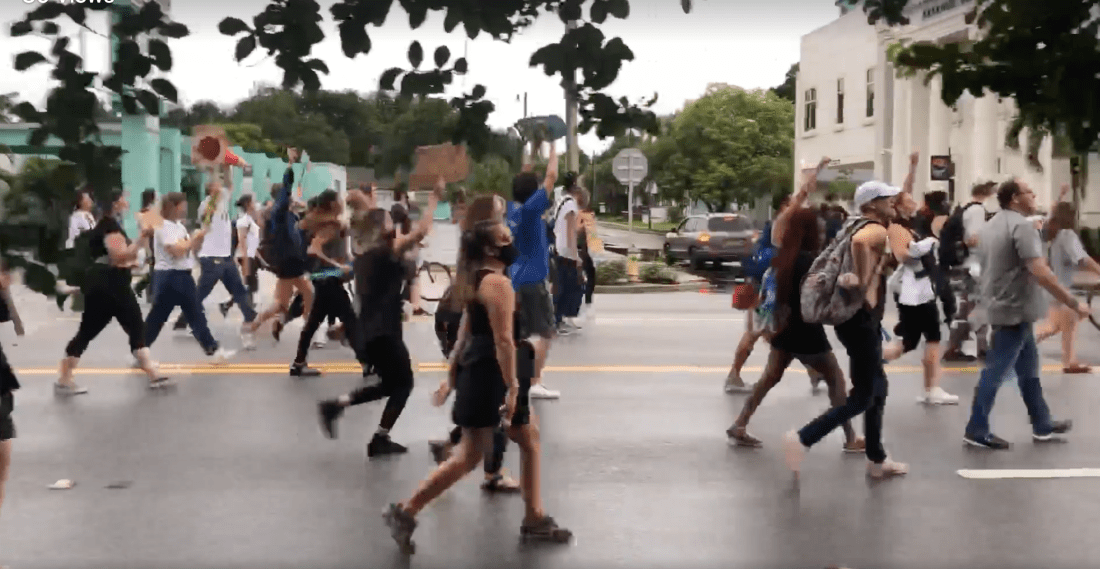
We seemed to have enough energy to power a small city as we marched from downtown St. Petersburg through a half-dozen neighborhoods.
I’d say most of the hundreds of people in the crowd ranged in age from late teens to mid-30s. I was an outlier. Many of us wore face masks and some people held homemade signs. (Silence = Complicity, one read. Another one, affixed to a bike, brought a surprising chuckle: “The revolution will not be dehydrated.” It was placed on a saddle bag that a cyclist had loaded with complementary water bottles.)
Filling darkening streets, we made enough noise to bring people to their front porches. Was a parade coming? Some folks seemed bemused, others cheered. Some motorists honked their horns. They all heard our call-and-response chants, which were sometimes led by those with bullhorns.
“No justice!” NO PEACE
“What’s his name?” GEORGE FLOYD
“When are we going to do this?” EVERY DAMN NIGHT
From my vantage point, in the middle of the sweat-packed group, uniformed law enforcement officers accounted themselves admirably. At first, for about the first half hour after I joined up, I’m not sure I saw a single police officer. (I mentioned this to a woman who was clearly a newspaper reporter. “It’ll be peaceful as long as the police don’t show up,” I remarked. “Yeah, where are they?” she responded, looking over her shoulder to see if she could spot any police. Here’s the Times’ story.)
But a few minutes later several police vehicles rolled around us into a parking lot, lights spinning, and soon enough we saw them at virtually every intersection. I was relieved to see that the officers were strategically moving along the route to give us easy passage. They parked their cars in the middle of side streets to block traffic until we passed by on the main thoroughfares.
All remained peaceful when I peeled off at almost 9:30 p.m. to head home, and I hoped it would remain so as the hour got later. I heard an organizer say they planned to continue on for roughly two miles south to the city’s most historic predominately black neighborhood.
My voice now feels scratched and I’m hoarse. In the distance, I hear a police helicopter circle. In my head, I just hear the chants, over and over.
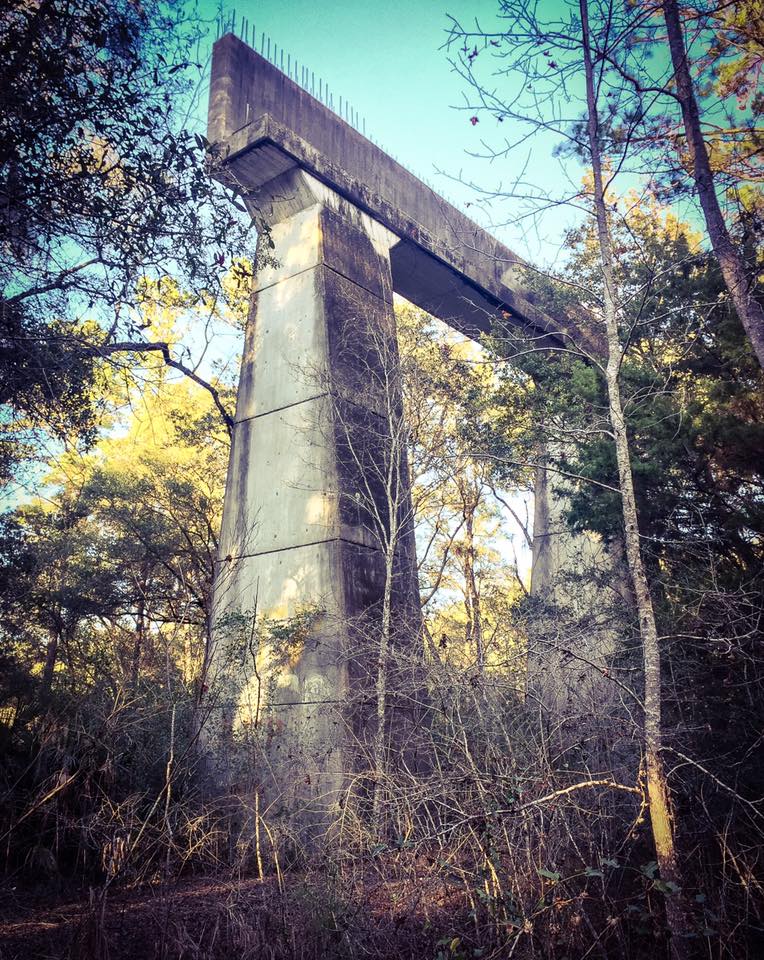
About six miles south of Ocala, in a wide jungle of a median of the divided U.S. 441, you will find symbols of Florida’s greed and racism hidden in the trees: Four bridge stanchions built in 1935 for the never-completed boondoggle known as the Cross Florida Barge Canal.
I discovered the place recently when I visited a little-seen side trail on the Marjorie Harris Carr Cross Florida Greenway while on a camping trip.
The canal was a long-dreamed idea to build a shipping channel across Florida to more efficiently move goods between the East Coast and the Gulf without having to ship around the Florida Keys. The project never really got going until the Great Depression when people were desperate for jobs. Work began in 1935 but federal appropriations weren’t steady and it was halted in 1936. Over many decades, through fits and starts, parts of the canal were dug and built, though less than 30 percent of it was ever completed. But that didn’t stop the federal and state governments from destroying the small African-American community of Santos, whose residents lacked political power and influence. Eminent domain was declared to make way for the canal right through the town and four bridge stanchions were built to carry vehicular traffic over the canal to be dug below. Historians say the black residents were forced to sell their property at fire sale prices and disperse for who knows where.
Today, just one of Santos’ buildings remains, the Pentecostal Temple of God. I’d guess it’s about a quarter mile from the bridge supports. Near the church is the old Santos baseball field, where black ball players took on rival baseball teams back in the day when every town worth its salt had a team.
The remnants of Santos and the bridge stanchions are scarcely noticed, if at all, by folks who visit the state’s Santos Campground, across 441 from “Port Santos.” The park is a trailhead for a portion of the Marjorie Harris Carr Cross Florida Greenway, a protected greenbelt named for the environmentalist who in the 1960s and 1970s fought against the canal and advocated creating a nature corridor on the route carved out by the state for the shipping channel. The Santos Trails have become a recreation magnet, known for having some of the best equestrian, mountain biking and hiking in the state.
But few folks knew what I was talking about when I asked how to find the bridge stanchions. Two women on horseback never heard of them. A surveyor along the highway didn’t know what I was talking about. Dano, the owner of Greenway Bikes, offered some directions but a third of a mile up the road I still couldn’t find them. A gray-bearded man, passing in a car, noticing me, carrying a backpack and looking over a map, pulled over and gave me directions to the bridge structures, which were fully hidden by tall trees, down a trail behind a Marion County Sheriff Office’s substation.
This artist’s rendering of the never-built bridge was posted on a bulletin board on a trail. The bridge was to span the Cross Florida Barge/Ship Canal, also never built.
The refrain of an old Army ballad, made famous by World War II Gen. Douglas MacArthur, goes, “Old soldiers never die, they just fade away.”
The truth is, America’s remaining World War II veterans—most at least in their late 80s—are leaving us; about 680 die every day, according to the Department of Veterans Affairs. In a few years, the last page will turn on these living, breathing history books, men who fought a war that resulted in more American battle deaths and wounded than any other U.S. conflict. Despite a wealth of documentary films and oral histories in the archives, countless stories of average citizen-soldiers remain untold or forgotten.
“It is sad to see that these simple heroes are leaving us at such a fast rate,” said Floyd Cox, volunteer administrator of an oral history program at the National Museum of the Pacific War in Fredericksburg. The museum has collected 4,400 histories, but most are locked in vast archives and none is available online. Volunteers remain busy capturing stories from veterans before the program inevitably winds down.
In honor of Veterans Day (November 11, the anniversary of the armistice that ended World War I in 1918), I interviewed more than a dozen Texas World War II veterans. They were mostly small-town and farm-raised kids propelled into deadly situations, living to tell how they survived parachuting into enemy territory, fighting in hand-to-hand combat, firing mortars and suffering frostbite, being stranded in the vast Pacific after the sinking of their ship and escaping a burning tank. Some opened up after years of reticence; some shed tears. One vet and his prewar bride demonstrated their everlasting love, and many told of their unfathomable will to live and immense gratitude.
Now, some 70 years after U.S. troops were pulled into the war, we get the rich details of lives so cruelly interrupted.
‘We didn’t even know where Pearl Harbor was’
On December 7, 1941, 17-year-old Jetty Cook and some buddies heard the news after they watched a matinee of “Sergeant York,” the World War I movie starring Gary Cooper.
“Extra, extra! Pearl Harbor attacked!” a paperboy cried.
“We didn’t even know where Pearl Harbor was,” Cook said of Japan’s bombing of the Hawaiian military base that instantly drove America into war.
A year later, Cook left his hometown of Big Spring and enlisted in the Army Air Corps. In the following months he trained as a gunner on a B-17 bomber.
On July 20, 1944, on a bombing run over Germany, his aircraft was hit by flak, which caused two engines to fail and another soon to catch fire. The plane limped westward as it slowly fell from the sky. The airmen jumped just before the bomber crashed somewhere in German-occupied Belgium. Cook parachuted, landed safely, quickly gathered up his chute and hid in some bushes. He watched as German soldiers captured fellow U.S. troops, narrowly escaping detection by a Nazi soldier and his dog.
When the coast was clear, Cook walked westward, drank from a muddy puddle and after midnight took a chance by knocking on the door of a modest farm house, not knowing whether he was in Germany. A farmer gave him some bitter coffee, black bread and shelter in a hayloft. The next day, a member of the Belgian Resistance questioned him at length to ensure he wasn’t a German plant.
Over the next two months, a cast of Belgian partisans took turns hiding Cook, who often posed as if he couldn’t hear or speak. He was periodically reunited with some of his crewmates and shuttled to safe houses, including a room over a bar frequented by German soldiers, a brothel (also visited nightly by the Germans) and a convent. He participated in a bank robbery to obtain food rations, helped a team of Resistance members blow up a railroad bridge to send a trainload of German troops to their deaths and helped capture German Gestapo agents after American and British forces began to liberate Belgium.
Cook and a fellow airman narrowly escaped death when a group of Belgians, emboldened by the retreat of German forces, captured them and put nooses around their necks, insisting they were German spies as they dragged them to a lamppost to be hanged. Then a young Belgian woman stepped up and said she knew the local police chief secretly housed an American and insisted they check. They phoned from a nearby store and verified Cook had been hiding out with the chief’s family. Within minutes, they broke out bottles of wine and they all celebrated.
Cook eventually made a career in the Air Force. Over the years, he returned to Belgium numerous times to reunite with people who aided him and attend anniversary events. Today, Cook, 88, lives in Hunt with his wife of 42 years, Wanda.
‘They were bayoneting and shooting everything that moved’
On May 18, 1942, five months after Japan bombed Pearl Harbor, Arwin J. “Jay” Bowden enlisted in the Marines. One of eight children born to a cotton farmer and his wife near Vernon in North Texas, he had just graduated from high school.
By November 1942, Bowden, quickly trained as a radio operator, was shipped off with his division to New Zealand, where they set up a defense force to guard against a possible attack by Japan and built camps for troops. Within a year, Bowden and his regiment entered their first combat at the Battle of Tarawa, a strategic atoll about 2,400 miles southwest of Pearl Harbor that U.S. forces needed to refuel aircraft and serve as a launchpad to retake the Philippines and, eventually, attack Japan.
Japan had built a landing strip on Tarawa’s main island and fortified the island with many stockades, firing pits, underground tunnels and concrete bunkers protecting big guns aiming down the island’s lagoon and beaches. One Japanese commander said it would take “1 million men 100 years” to conquer Tarawa. “This was probably the most fortified 290 acres in the world,” Bowden said.
Before dawn on November 20, 1943, Bowden was aboard a troop transport with about 2,000 Marines, part of the largest U.S. operation in the Pacific at the time. He was among troops sent ashore on landing craft known as Higgins boats, but his boat got stuck on a reef. He and 32 other Marines boarded two amphibious track vehicles to get ashore. As they approached the beach, the Japanese blew up Bowden’s vehicle and killed most of the men who were with him.
The fire burned off nearly all of Bowden’s clothes except his boots, knife belt and the leggings he wore under his uniform. His right ear was nearly burned off, as was most of his hair. He dove into knee-deep water and then hid with five other Marines behind a second vehicle. They nursed their wounds and stayed there as Japanese soldiers aimed their weapons at other targets. Near dusk, they decided their best hope was going into deeper water—to the reef about 500 yards out, where they hoped for a rescue.
Earlier in the day, Bowden had picked up a waterlogged rifle that was useless except for the bayonet at the end. As they moved out, Japanese soldiers spotted them by the light of the fires on the island. “They came out and they were bayoneting and shooting everything that moved,” Bowden said. Several enemy soldiers came near, and Bowden somehow got close enough to one of the Japanese carrying a machine gun to plunge his bayonet into his chest.
In such an adrenaline-charged moment, “you don’t know where all your energy is coming from, and you don’t remember where or when. Anyway, I survived,” Bowden said.
He and the two other surviving Marines scrambled away and were picked up by a U.S. ship on which they received immediate medical attention before being sent to a hospital in Honolulu.
Meanwhile, after 76 hours of fierce fighting, the Marines took the island but suffered more than 1,000 deaths and 2,000 casualties, while the Japanese lost more than 4,600 troops. Tarawa shocked the nation for its high cost in U.S. lives and was the subject of a documentary that won an Academy Award in 1944.
Bowden, 89, recovered after six weeks of medical care and returned to participate in other battles in the Pacific. After the war, he spent most of his work life at Southwestern Bell. He is a widower and lives in San Antonio.
‘I was thrilled to death because he came back whole’
World War II veteran Marion Henegar.
It was 1939 in a small town in Oklahoma when Marion Henegar, 21, married his sweetheart, Oletha, just 17. By 1943, Henegar had entered the Army Air Corps and spent three years as a radio operator on a C-47 that hauled supplies and paratroopers to the front lines in Europe.
To drop parachutists, Henegar’s aircraft often flew low, just 650 feet above ground, plenty close enough to be shot down by the Germans. “When we got back, we’d count the holes in the planes,” Henegar said.
For three years, Henegar and Oletha corresponded constantly. “We wrote sometimes once a day, sometimes two,” Oletha said.
Oletha sent her husband care packages with ground coffee, canned milk, pecan pies and—once—a pair of boots better-made than his Army-issued pair. Because of weight limits on packages, she sent each boot separately.
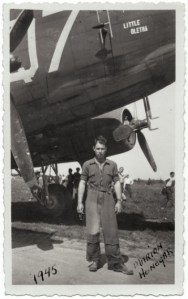
Near the end of the war, Henegar and his crew were assigned a new C-47. The only married one of the bunch, Henegar was given the honor of naming the plane. He chose “Little Oletha.” Henegar proudly showed a black-and-white photo of a strapping young man in a jumpsuit, standing under the plane with his wife’s name painted on the fuselage.
After the war, Henegar flew back to the States, landed in Boston and hopped a bus back home. Oletha drove to pick him up at the bus station in Tulsa, Oklahoma. It was swarming with giddy GIs who grabbed any female they could.
“They would run if they saw a woman, and they would hug her and kiss her and fling her in the air. They were so happy the war was over,” she said. “Most of them were drinking. It was wild.”
Oletha wanted none of that, so she hid behind a tree and snuck into the terminal. She was at the door of the bus station when Henegar stepped off the bus. “Oh, he looked wonderful. He was a very handsome Air Force guy,” Oletha recalls. “He still is. I was thrilled to death because he came back whole, and I felt for the ones who came back the other way.”
“We spent lots of time kissing and hugging, and we couldn’t keep our hands off one another,” Oletha said. “We were looking forward to being together again.”
The couple had two children and moved to Texas, where Henegar spent 37 years in the energy business, making use of the skills he developed in the military to operate electronic instruments to find oil for Phillips Petroleum Co. and Chevron. This year, the Henegars marked 73 years of marriage.
“I’m proud that I served in the war,” said Henegar, 95, who lives in Livingston. “You just do what you’re supposed to do. And I thank the Lord for watching over me.”
‘I thought it was angels coming’
In July 1945, L.D. Cox was a 19-year-old helmsman aboard the USS Indianapolis, a heavy cruiser that carried a secret wooden box across the Pacific to the small island of Tinian. He later learned the box contained parts and enriched uranium for the atom bomb nicknamed “Little Boy,” the weapon loaded on the aircraft Enola Gay and dropped on Hiroshima.
Just after midnight on July 30 and one week before the dropping of the atom bomb led to Japan’s surrender, Cox’s ship was struck by two torpedoes fired by a Japanese sub. The more than 600-foot-long Indianapolis sank in just 12 minutes, resulting in one of the most dramatic stories of the war.
With the ship quickly going down, Cox put on a life preserver and handed one to the ship’s captain, Charles McVay. In the ensuing chaos, the captain ordered the sailors to abandon ship.
For the next four days and five nights, Cox and hundreds of men floated, most without food and water. Many men died of dehydration, drowning and attacks by sharks, which Cox could see circling under the surface. Some hallucinated and swam off, never to be seen again. Dying of thirst, one sailor removed his life vest, went under to drink the saltwater and died within about two hours with brown foam around his tongue and mouth.
Cox floated with a pack of about 30 others. A couple of days after the sinking, Cox remembers a shark surfaced and locked onto a sailor floating only three feet away from him. “He came up like lightning and took him down and you couldn’t see anything else,” Cox said.
Cox and the remainder of his group who survived slowly sank lower and lower in their waterlogged life preservers, their noses barely above the water after being afloat more than 100 hours. They were finally rescued when a U.S. pilot saw them by chance one afternoon. Ships were eventually dispatched and picked them up after dark. Cox remembers seeing a spotlight shining up into the dark sky, a beacon of hope from a ship that many sailors later said saved their lives by giving them the will to hang on. “I thought it was angels coming,” said Cox.
The sinking of the Indianapolis resulted in the deaths of almost 900 of the 1,200 men on board. McVay, who also was rescued, was later court-martialed for failing to zigzag to avoid torpedo attacks, a controversial rebuke that Cox and other survivors never have supported.
After the war, Cox graduated from Texas A&M University, served as state sales director for a livestock feed company and operated a ranch. He still owns an 800-acre cattle ranch and lives in Comanche with his wife of 63 years, Sara Lou.
Only the grace of God—and his strong will to survive—allowed him to live, said Cox, 86, who frequently speaks to groups of schoolchildren about his war experience. Unlike some senior citizens chagrined by young generations, Cox expresses optimism and encourages elders to impart strong moral leadership and guidance on today’s kids, who one day will lead the country.
“What I tell them is freedom is not free,” Cox said. “Somebody has to fight to keep our freedom.”
A little before 4 a.m. on December 7, 1941, J.C. Alston was wakened by a fellow sailor as he slept in a bunk on the USS California, the lead ship moored to docks adjacent to Ford Island in the middle of Pearl Harbor. It was Alston’s turn to take up watch on the port side of the battleship’s quarterdeck. His shift was from 4 a.m. to 8 a.m.
After waking the officer of the day and the chief boatsmate, Alston stood under a clear dark sky filled with stars and a waning moon. He could see the silhouette of the battleship’s coning tower and its gun batteries. As always, the crew was to awake the captain if they saw any threat, but the eighteen-year-old sailor had never had an occasion to waken him.
Sometime around sunrise, the bugler sounded reveille. The harbor water was so glassy smooth that Alston watched a PBY pontoon plane repeatedly fail to take off from the surface of the harbor’s waters. (PBY is short for “patrol bomber” with the “Y” the military designation for its manufacturer, Consolidated Aircraft.) Needing choppier water to get lift, a PT (patrol torpedo) boat cruised in circles to create a wake and the seaplane was soon aloft. On the forward deck, sailors put up a white awning for Sunday morning religious services. Small boats arrived with GIs planning to attend. His shift nearly over, Alston was ready for next sailor to relieve him. He was hungry for breakfast.
He then heard the noise of aircraft flying in his direction and saw low-flying planes coming from behind a mountain on Oahu. “I didn’t know they were Japanese at the time. I thought some aircraft carriers were training,” Alston said, remembering that the USS Lexington left the harbor the night before laden with planes.
“Those are Japanese planes!” the boatsmate yelled. “Japanese planes!”
The bugler sounded general quarters calling sailors to their assigned battle stations. Alston’s heart raced as he ran to his, the number two 14-inch-diameter gun on middeck, and slid inside its turret. He was a gun loader.From his darkened space he could hear a barrage of sounds – roaring planes, machine-gun and anti-aircraft fire, sirens. He felt the ship violently rock when it was hit by torpedoes below its water line.
According to the action reports filed after the attack, the California was struck by two torpedoes on its port side at 8:05 a.m. and then blasted by another fifteen minutes later. At 8:10 a.m. Alston heard the loudest explosion: The bomb that blew up the USS Arizona. Blinding smoke filled the sky and fire lapped the water.
Alston’s ship also was nearly hit by four bombs that caused serious flooding and at 8:30 a.m. a bomb penetrated to its second deck where it exploded and sparked a tremendous fire that killed about fifty men.
“Fire was everywhere,” Alston recalled. The listing ship was ordered abandoned because of the threat that that it would blow up. Alston emerged from his turret and joined other sailors to leap from the quarterdeck and swim about twenty yards to nearby Ford Island. Drenched and wide-eyed, the boys were partially hidden by smoke but they could see Japanese planes bombing and strafing. They seemed close enough to throw a rock and hit the low-flying planes, which swooped down and then pulled up at the last second to avoid the towers of the burning battleships. “There were so many I don’t know how they missed each other. They were like a bunch of bees,” Alston said.
On Ford Island, officers mustered their men for roll calls to see who was still alive or missing. Soon, Alston and other sailors were ordered back aboard to man the guns on the California that remained above water. This time they scrambled across timbers that had been laid across to the quay, climbed a ladder, and pulled themselves on board.
In an almost comical confusion of combat, another abandon ship order came minutes later as the ship continued to sink despite valiant efforts to keep her afloat. The inrushing water could not be isolated and the California settled into the mud with only her superstructure above the water.
“Anybody who says they weren’t scared, well, they’re just not quite telling the truth,” Alston said as he told his story in the living room of his home in Troy, Texas. “Of course it hits them after it’s over more than it did at the time.”
Roughly one hundred of the California’s crew died and sixty-one were wounded.
Dying never entered Alston’s mind until that day. He joined the navy just five months before the attack after he had dropped out of high school. He and two buddies hitched a ride to the Dallas recruiting station. Girls were on his mind and the legend of sailors having one in every port, Alston said, smiling at the memory. He also was pragmatic: Finding work during the hard-luck days of the Great Depression was difficult if not impossible. But in the navy, “I’d have a job, three meals a day, a place to sleep and it was warm and dry,” he said.
Alston was born March 3, 1923 in Cone, a hamlet about thirty-five miles northeast of Lubbock. The middle of seven children in a farming family, he grew up during the bitter dust bowl years on the Southern Plains. He remembers when electricity came to the community and they began using light bulbs instead of kerosene lanterns. Alston was a young teen-ager when his parents hung up their plow and moved to Temple in Central Texas. His father became a carpenter.
Even with the threat of war, Alston’s parents voiced no objections to his decision to enlist. Some of Alston’s relatives had already joined the navy, and Alston considered oceanfaring the best choice. On a ship, he wouldn’t have to trudge the frontlines as an Army infantryman. “Why walk when you can ride?” Alston said with a laugh.
After about six weeks in boot camp in San Diego, Alston reported to Long Beach for his first duty on the USS California. He was assigned to the deck crew’s division two, port side, which mostly meant cleaning, painting, and maintaining a section of the six hundred-and-forty-foot-long, 30,000-ton battlewagon. On October 1, 1941, they set sail for Pearl Harbor.
Just nine weeks later, in the midst of the Japanese attack, a frightening thought leaped into Alston’s mind: I could die here. He has no good explanation for why he didn’t. Alston said he and the other boys who escaped from the burning and sunken ships instantly bounded with a common purpose: to avenge the attack that killed thousands of their brother sailors. They slept together on cots in a hangar and then squeezed into barracks or strung up hammocks in ships with less damage. Alston found a berth on the USS Maryland, a battleship that hadn’t sunk despite being hit with a bomb.
In hushed voices, the shell-shocked survivors talked about what war meant, but they had little time to ponder their good fortunate. They were on guard against another attack and they got to work to salvage and help repair America’s devastated Pacific Fleet. Alston was assigned watch duty and manned five-inch guns that were taken off the California and moved to the nearby gunnery range.
In time Alston was assigned to the West Virginia, which was fitted with temporary patches to its hull, refloated, and moved to a dry dock for repairs. He helped hook up hoses to pump tens of thousands of gallons of fuel and oil and contaminated water to barges. He was among a group that went below deck to pull up bedding, furniture, and other debris. They found dead bodies.
“When we came across a body we hollered up ‘There’s a body down here!’ ” Alston recalled. Marine corpsmen and medics clamored down and retrieved the body, placed him in a bag, and carried him away. Alston remembers the stench. “It stunk. That old oil stinks anyway.”
On their uniforms they wore white tape that had been treated with some kind of chemical. This was their canary in the coalmine. If the tape turned purple they were in danger of being asphyxiated by vapors and they were ordered to a platform that another sailor above cranked to carry them out of the hold and into the fresh air.
Alston learned firsthand the sad story of how, in rare moments of quiet after the attack, rescuers had heard faint sounds on the West Virginia. Bang, bang, bang. The noise came from somewhere below. Old-timers told Alston that sailors had been trapped deep below in an compartment that still had some air. They were banging on pipes. But the sailors above were helpless to save them because even if divers could isolate where they were and cut the ship open the pressure and overwhelming surge of water would drown those trapped and possibly kill the would-be rescuers. Bang. Bang. Bang. Salvage crews eventually found the bodies of three men huddled in an airtight storeroom. They hadn’t drowned; they died from a lack of oxygen and may have lived until December 23. The crew found a calendar with them on which sixteen days had been crossed off in red pencil.
In 1943, Alston was on the West Virginia as it sailed back to the West Coast for final repairs and modernization with more weaponry. It returned to service in 1944 as the tide turned in favor of the United States. Alston and the West Virginia took part in major battles that helped America take control of the Pacific: the October 1944 Battle of Leyte Gulf, the retaking of the Philippines, and the deadly 1945 battles for the strategic islands of Iwo Jima and Okinawa, where thousands of Marines died in gruesome combat against entrenched Japanese soldiers hidden in vast networks of caves.
Off the Philippines, Alston said he watched as five Japanese kamikaze planes plunged from the sky to try to ram into the ship. Four of the suiciders crashed or were shot down. But the fifth crushed into a superstructure deck just forward of a secondary battery, killing four men and injuring seven. Luckily, the aircraft’s bomb didn’t go off and West Virginia crewmembers carefully dislodged the unexploded weapon and dropped it overboard, Alston said.
The ship sailed to New Zealand for repairs and then joined the fleet for the attack on Iwo Jima, where it bombarded Japanese hideouts. On February 23, 1945, from his position offshore, Alston witnessed six GIs raise a U.S. flag on Iwo Jima’s Mount Suribachi, a ceremony that was staged twice. The photograph of the second flag raising captured by Associated Press photographer Al Rosenthal instantly became the war’s most famous shot.
On September 2, 1945, Alston was on the West Virginia’s deck in Tokyo Bay Japanese officials joined Admiral Chester Nimitz, General Douglas MacArthur, other allied commanders on the nearby USS Missouri to sign the instrument of surrender, officially ending the war weeks after the United States dropped atom bombs on the Japanese cities of Hiroshima and Nagasaki.
Alston was discharged in October and returned to Texas. He drifted to Lubbock where he helped a relative harvest wheat and then returned to Temple and landed a job as a truck driver at a Veterans Administration hospital. In 1949, he married a local girl, Arita June, and they had two daughters. He remained at the VA for thirty-four years in a variety of positions, including as fire department crew chief and supervisor of laundry service. After nearly sixty years of marriage, his wife suffered a heart attack and died in February 2008.
It took many, many years before Alston was able to forgive the Japanese, but forgive he has. The widower often tells his story to schoolchildren and attends veterans’ reunions and events. He has returned to Pearl Harbor many times and had served as the president of the Central Texas chapter of the Pearl Harbor Survivors’ Association, which disbanded in 2011 because so few survivors are alive and many of those who remain are too ill or frail to travel.
On December 7, 2012, Alston was one of four Pearl Harbor survivors to attend ceremonies commemorating the battle at the National Museum of the Pacific War in Fredericksburg, Texas. A year later he was the lone survivor to attend.
Before I left his home and walked into the darkness, Alston presented me a copy of the official document of surrender that ended the war and a spectacular color photograph of the memorial in Pearl Harbor that stands atop of the entombed USS Arizona. A perfect rainbow stretched from horizon to horizon directly over the site.
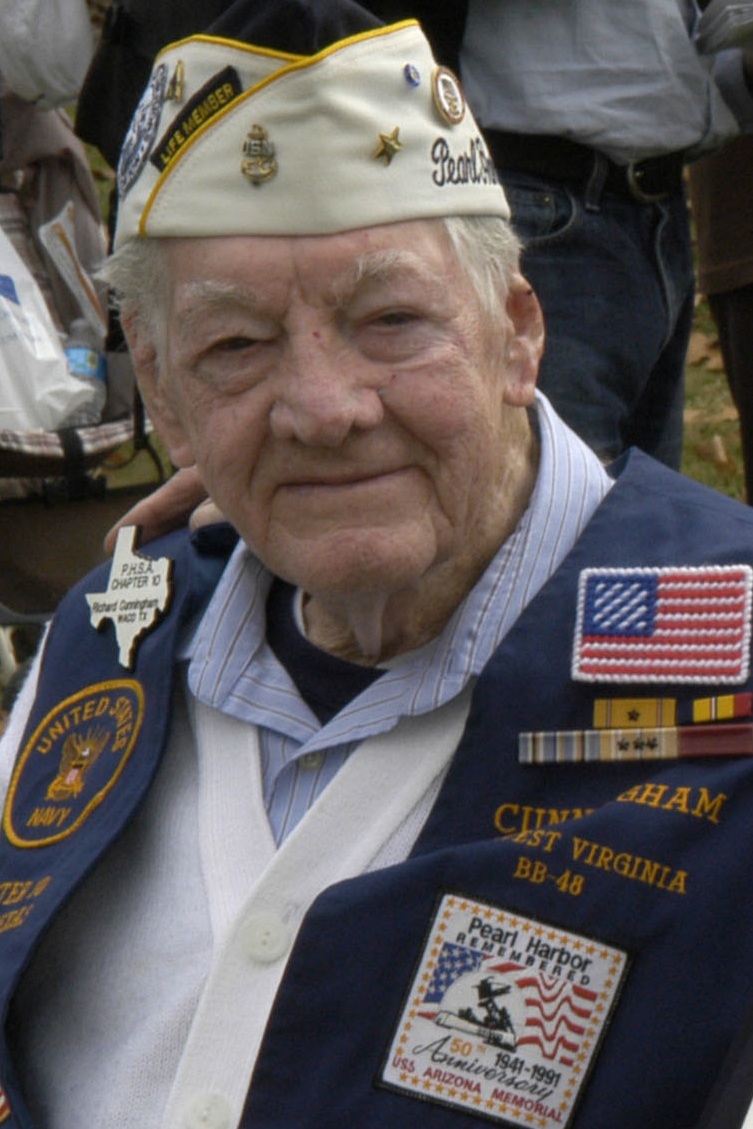
Shortly after sunrise, Seaman 1st Class Richard Cunningham and two other sailors, Earl Kuhn and Bill Morris, boarded a wooden boat tethered to their battleship, the USS West Virginia. They got underway at 7:50 a.m. and motored across the placid water. Theirs was a most routine assignment that morning: cross the harbor to a dock near the officers’ club where several officers waited for a pick up.
Despite all the talk of an impending war, crews were not on high alert. December 7 was a Sunday and Sundays were leisurely. Sailors were at ease. Officers slept onshore. Some men nursed hangovers from a Saturday night in Honolulu, others gathered for Sunday morning services topside. Watertight hatches and doors on the big warships–compartments designed to confine damage and flooding to a small area in an attack–were open.
The day before, Cunningham took shore leave and shopped for a Christmas gift for his mother. He bought her a cameo brooch, which he stored in his locker beside his bunk on deck.
After a restful night’s sleep, Cunningham was dressed in his Navy whites and stood on the boat’s wooden deck to enjoy the cool breeze. Looking across the smooth water, he held onto the sparkling brass railing, shiny from the endless hours of polishing by Cunningham and the crew.
Suddenly, the calm was shattered by loud sounds and the sight of torpedo bombers swooping down directly overhead and skimming the water’s surface. Cunningham found himself with a front-row seat to one of history’s biggest events—the attack on Pearl Harbor.
Cunningham remembered looking up and recognizing the red discs on the sides of the Japanese torpedo bombers, discs sailors called big red meatballs.
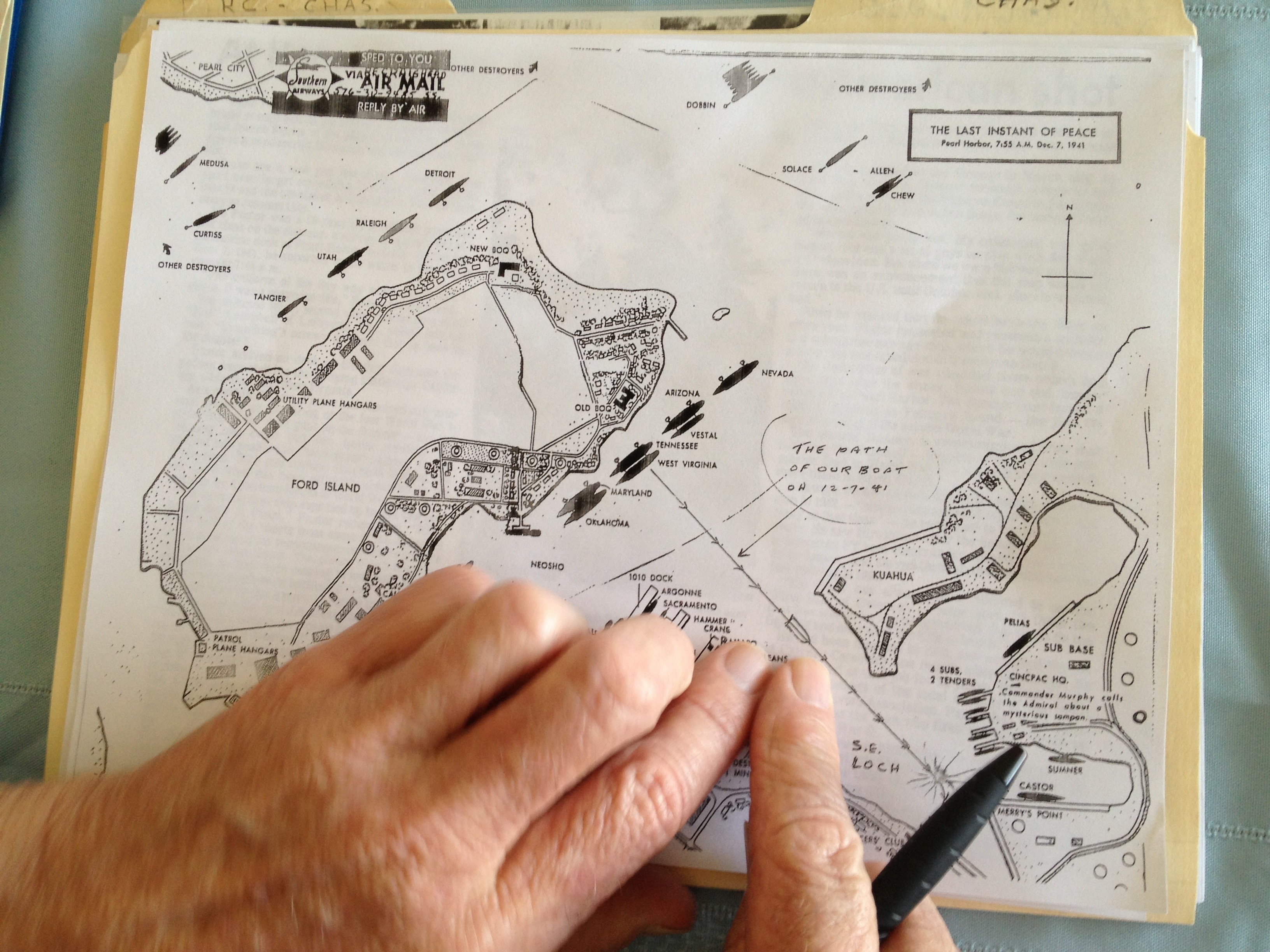
Richard Cunningham points to the location of his boat in Pearl Harbor.
“At 7:55 we’re right here and we’re facing these torpedo planes,” Cunningham said pointing at the spot on a map he had carefully written “the path of our boat on 12-7-41.”
“There was a big blast and we saw those two meatballs and we said to ourselves, ‘This is it! This is it. Those are Japanese and we’re at war. This is no training. This is no drill.’ ”
Seventy-one years after that day, the silver-haired Cunningham told his story while at the home in Hewitt, Texas he shares with Patty, his wife of twenty-nine years. He is among the few people still alive to witness firsthand the event that thrust the United States into World War II.
Cunningham is a retired aerospace industry employee who has spent most of his life in Texas. He grew up in Irondale, Ohio, the eldest of four. His father, a veteran of WWI, worked in a brickyard and the family lived in the back of a grocery store during the dark days of the Depression. Cunningham learned to fish and hunt rabbits and groundhogs.
“I grew up with a gun in my hand,” he said. “I kept my family in meat.” After graduating high school, one of Cunningham’s buddies, nicknamed Little Joe, pestered him to join the Navy.
“He asked me one time too many times.” He told Little Joe, “Let’s go!” Cunningham was attracted by a steady military paycheck. They enlisted in Youngstown. They trained at the Great Lakes Naval Station near Chicago and then went separate ways. Cunningham shipped off for duty on the 623-foot-long USS West Virginia, commissioned in 1923 and yet still the nation’s newest battleship. It was being refurbished at the naval shipyard in Bremerton, Washington. Cunningham’s first job was to scrape barnacles off the sides of the ship. In late 1940, it relocated to Pearl Harbor with the rest of the Pacific fleet.
Richard Cunningham at the 2012 Pearl Harbor commemoration at the National Museum of the Pacific War in Fredericksburg, Texas.
As with other WWII veterans, Cunningham is something of an amateur historian. Close at hand was a stack of a half dozen manila folders filled with war-related documents, photos, and maps, as well as war books, including one entitled Betrayal at Pearl Harbor: How Churchill Lured Roosevelt into World War II.
At age ninety-two, Cunningham retains a good memory. He has memorized more than four hundred gospel and bluegrass songs and plays the mandolin and guitar. The challenge in interviewing him was his hearing difficulties, and he often turned to his wife to relay questions. “Patty is my second ear,” he said.
He carefully laid on his kitchen table an aerial map of what Pearl Harbor looked like that morning, including the location of all the major ships and facilities. The West Virginia and six other battleships were anchored two-by-two at Ford Island, a 330-acre isle in the middle of Pearl Harbor used by the U.S. Navy to moor ships, for an airfield, barracks and other facilities. All around the harbor there was a mighty assortment of ships: another battleship, the USS Pennsylvania, was in dry-dock at the Navy Yard, plus nearly ninety others: destroyers, cruisers, tenders, survey ships.
Cunningham continued his story. “One after another, we’re facing these torpedo planes. You’d look up and see these guys, and they’re grinning from ear to ear. They had the machine gunner behind them. But the pilot of our boat, Earl Kuhn, he kept that boat right underneath these Japanese torpedo planes. The planes were dropping torpedos, which were running under and beside our boat. But he kept it there because had we cut and run I wouldn’t be talking to you now because the machine gunner would have got us. We’re right underneath and the machine gunner can’t shoot down.”
Alarms and general quarters announcements sounded, calling all sailors on ships, as well airmen at Hickman and other airfields, to battle stations. In four minutes, Cunningham witnessed one of the first American shots of the war. Two sailors on the USS Sumner, a survey ship moored at a nearby submarine base, fired its World War I-era guns. They hit one of planes point blank.
“There was a ball of fire so close that it singed my eyebrows and the hair on the back of my hands,” Cunningham said, wide-eyed, remembering the scene. “And the plane just disappeared. The ball of fire just melted it. And the propeller went spinning toward Kuahua [a peninsula that housed a new supply depot].”
The action report filed by the ship’s commanding officer following the attack corroborates Cunningham’s story:
0757 Signal watch and quartermaster on bridge sighted approximately 10 dive bombers, marked with red discs, attacking Navy Yard. … 0759 Went to general quarters. Observed torpedo planes approaching from S.E. over Southeast loch, attacking BB’s [battleships] at Ford Island Mooring Platform, circling Ford Island, and flying off to S.W. Red discs plainly visible on planes. 0801 … Gun crews opened fire immediately on manning guns without waiting to establish communication with control. … Sumner was first ship in vicinity to open fire. … 0803 Torpedo plane passed close aboard, within about 100 yards of Sumner’s stern, on W. course, altitude about 75 feet, leveled off for launching torpedo at BB’s. Plane continued on its course until it was about 300 yards distant from Sumner’s stern, wh[en] it was struck by a direct hit from Sumner’s No. 3 A.A. gun. Plane’s gasoline tank believed ignited, as plane immediately disintegrated in flames and sank in fragments. Torpedo believed sunk without exploding. …
Cunningham saw the eighteen-foot torpedo of the vaporized plane fall into the water. “It went straight down and then it came back up. It resurfaced. When the torpedo came back up it started going in an erratic fashion like this,” he said, holding out an arm and moving it back and forth. The torpedo locked onto their boat. Though the hull was made of wood, it had a metal motor, and it headed right for them. Japanese torpedoes were equipped with honing devices to fix onto metal objects.
“So the coxswain–old Kuhn–put the pedal to the medal. We went into the dock area near the officers’ club landing. Bill Morris was the bow hooker and he had his line in hand and I was the stern hook and I had my line in my hand and we both, we swear, we jumped six or seven feet to that landing. That was the fastest tie-up in history that day [laughs].” The three men ran up the landing and ducked behind a concrete abutment, hoping to avoid the explosion. “We made it and we thought there would be the big explosion when that torpedo hit that dock. But it didn’t happen.” They peeked up over the abutment to see that the torpedo had beached itself on a sandbar between the dock’s pilings.
Cunningham and his crew mates witnessed the attack from their boat in the middle of the harbor.
They looked across the harbor could see the whole thing, the whole attack, as enemy planes continued to pour in, fires raged, and smoked filled the air. “At 8:10 we saw the Arizona blow up. We saw the Oklahoma turning over, and found the West Virginia taking torpedo hits.”
They ran back to their boat and headed right back into the harbor, its water slick with oil and fire. As ships began to fall, hundreds—thousands—of men jumped or fell into the water. Cunningham and his men picked up “boat load after boat load” of them.
“We’d pick these guys up out of the water and we’d bring them to the submarine base. This is still the first attack.” They watched as men wrenched themselves from portholes barely 18 inches in diameter, their eyes wide and their faces frenzied as Cunningham and the others pulled them into their small ship.
“You wouldn’t believe how some of these guys would open the porthole and the water was rushing in and they pulled themselves up against that water, out the porthole, and came up to the surface,” he recounted. One man was so panicked, so frantic, that Cunningham hit him just to get him to settle down.
“He was like a mad man. I hit him with the fist. It might have been the wrong thing to do but [I had] to settle him down, and he did. He sat. He was no problem after that and we picked up some more men and put them in there with him. And then we got over and carried them over to the submarine base and let them out.”
In the first of Japan’s two waves, all the battleships took bomb and or torpedo hits. The USS Oklahoma turned over and sank. The USS Arizona was mortally wounded by an armor-piercing bomb that ignited the ship’s forward ammunition magazine and the resulting explosion and fire killed 1,177 crewmen, the greatest loss of life on any ship that day. The California, Maryland, Tennessee, Nevada, and Pennsylvania also suffered heavy damage.
Cunningham’s ship, the USS West Virginia, was hit by two armored-piercing bombs through her deck and five aircraft torpedoes in her port side. Heavily damaged by the ensuing explosions, and suffering from severe flooding below decks, the crew abandoned ship while the West Virginia slowly settled to the harbor’s shallow forty-five-foot bottom. Of the 1,541 men on the West Virginia, one hundred and thirty were killed and fifty-two wounded.
The second attack came about an hour later.
“The second attack was bombs mostly. We stayed out in the harbor. The thing is when these guys released these bombs they would take a pass at us with their machines guns. One of them knocked out a window in our boat. None of us three got hit. But of course the boat, had a couple bullets in it [(laughs].”
“We stayed out in the harbor getting these guys who were injured to the submarine base. It’s a funny thing but you think about your buddies. You think about other guys and think how you can help somebody else. You don’t go someplace and hide. You get out there and you start looking for some guys you can help and that’s what we did.”
On December 16, Cunningham’s mother received a telegram from the Navy. Her son was lost and presumed dead. The telegram read:
The department extends to you its sincerest sympathy in your great loss. To prevent possible aid to our enemies please do not divulge the name of his ship or station. If remains are recovered they will be interred temporarily in the locality where death occurred and you will be notified accordingly. Rear Admiral C.W. Nimitz, chief of the Bureau of Navigation
It wasn’t until December 19 that the Navy sent another telegram with the news that he was a survivor. Cunningham said he wasn’t able to call to clear the mix up because phones were inoperable.
And, besides, he and his mates were busy with countless duties after the attack, helped put out fires and salvaged ammunition that divers brought up from sunken ships. Orphans as such, with their ship home unavailable, they slept on their boat and lived on peanut butter and crackers they had on board.
After helping put out the fire on the Arizona, the three men headed for what had been their home, the West Virginia.
Pearl Harbor has a mean depth of forty-five feet and battleships have a forty-foot draft. Despite being hit with seven torpedoes on its port side, the West Virginia gracefully sank to the bottom after two sailors opened valves to let water out on starboard side to counter the floodwaters pouring in the port side. This allowed the great ship, longer than two football fields, to settle in a somewhat level position.
Cunningham and his crew tied up alongside. They climbed aboard and waded knee-deep in the black, oily water across its deck. Cunningham found his locker. His belongings were all burned up, including his photo album and even the medals he won for besting other sailors in rowing and sailing competitions. Just one thing was not destroyed: the brooch. Just before Christmas, after being assigned a bunk in a barracks onshore, he mailed it to his mother.
Cunningham served the rest of the war helping to run supply and troop ships that sailed into battles across the Pacific, including Guadalcanal, the Treasury Islands, New Georgia, Rendova, and Bougainville. In one fight, he fired a machine gun at diving Japanese planes, his bare feet on the ship’s railings to avoid hot shell casings that littered the deck. Another night, near New Georgia, his ship struck a reef and all but sank. Some coral kept its bow out of the water and he and his shipmates huddled there and clung for life. They were rescued by a U.S. minesweeper the next day.
In March 1945, remarkably more than four years after he joined the Navy, Cunningham returned home for the first time since he shipped out, an occasion marked by a story in the local paper.
Cunningham’s brooch.
After the war, he had a brief marriage and a long one and four daughters. He moved to Texas and worked in the aerospace industry. Among other things, he wrote and prepared engineering and performance documents on F-111 fighter jets for General Dynamics in Fort Worth. Nearly thirty years ago, he married a third time, to Patty, who also remembers WWII from the perspective of a schoolchild.
In 1993, two years after his mother’s death, Cunningham donated the brooch to the National Museum of the Pacific War in Fredericksburg where it is on display.
In May 2012, on the anniversary of Victory over Europe, Melvin Waters met Margaret Hopkovitz, a survivor of the Bergen-Belsen concentration camp. (Photo by Deborah Brown)
Melvin Waters is legally blind, a result of suffering from macular degeneration. But he can still see and smell that time in late April 1945 when he came upon the Bergen-Belsen, a concentration camp in northwest Germany.
Historians say about 70,000 Jews, Russians, and other prisoners died at Bergen-Belsen during World War II. Among those who perished was Anne Frank, who died of typhus in early March 1945 only weeks before the camp was liberated on April 15, 1945 by a British armored division. Soldiers discovered roughly 53,000 prisoners at Bergen-Belsen, most of them half-starved and seriously ill.
Waters, an ambulance driver, arrived a little more than a week after the camp was liberated. He was assigned the duty of stretcher bearer.
Twenty years old, Waters never imagined this. He grew up in Lancaster, Texas, the son of a yeast salesman. After the attack on Pearl Harbor, at age seventeen, Waters tried in vain to join the war effort: first signing on with the Marine Corps and then the Army Air Corps. Both rejected him after he failed physicals. Unbeknownst to him he had high blood pressure. Then in the spring of 1944 he saw an advertisement in the Dallas Morning News and got a chance to join the war as an ambulance driver for American Foreign Service, an organization that was recruiting drivers and rounding up U.S.-made Dodge ambulances to support British and other foreign troops.
Waters was shipped overseas with platoons of other American drivers and in early 1945 they accompanied British, Polish, New Zealander, and Canadian troops up the boot of Italy through France to Belgium and Holland and across the Rhine into Germany.
“We came out of the woods and there on our left was the concentration camp. We were pretty close to the front of the convoy and I noticed that the convoy slowed down to a very slow pace,” Waters said. “And I guess I must have questioned what was going on. And then about that time I looked over to the left and there was a concentration camp. It was the first I knew we were going to a concentration camp.”
What did you see?
“There were a lot of people milling around and lot of them outside with striped convict uniforms on and people just kind of acted like they were in a stupor.”
They seemed in a daze?
“They stared blankly. They looked at us and looked right through us. There was barbed wire. The gate was wide open. A lot of them were outside in a ditch and they just looked like they didn’t know what to do. This was before any evacuation.”
“There were ashes everywhere and the smell: It was the most awful smell I’ve ever smelled,” he said.
Bergen-Belsen was first used to imprison Russian soldiers and then, starting in 1943, housed Jews and others. The Germans burned the bodies of thousands of prisoners in the camp’s crematorium. When it was liberated an estimated 13,000 unburied corpses were lying around the camp.
Waters helped transport those in the women’s barracks to a make-shift hospital. The first woman they approached tried to fight them off, throwing up her arms in defense. She feared that they were going to take her to the crematorium, where Waters said rumor had it the Germans burned alive weakened prisoners.
“She was very frail and completely out of her head,” he said. “Skin and bones.”
“She was in a bottom bunk and the British soldiers were taking her clothes off and we were there with a stretcher and we had to help her. She had a dress on and we took it off of her and wrapped her in a blanket.”
How old was she?
“It’s hard to say. All of them looked old, whether they were young or middle-aged or anything else. Being in a concentration camp they all looked like old women.”
They transported her to one of the small huts near the hospital that was set up in a former S.S. barracks. “We turned them into receiving stations. They would all be stripped of clothing. They cut their hair, de-liced them, put some clean clothing on them, and sent them to the hospital.”
“We used two men to a stretcher. We made probably a dozen trips a day or something like that. We had to line up. We had 72 men there eventually. We kept getting men from other platoons. We had near 50 ambulances there. That’s not official. We had the British medical team and I have pictures of them when they had protective gear. We all got gray hair.”
Why?
“That dusting that they put on you (to kill lice).”
“The ones we picked up were all too weak. The doctors, they were checking on the ones they could save and passing up on the ones that they couldn’t save.”
What did that feel like?
“You got where you didn’t have any feeling. You really did. Boy the smell was terrible. We drove up out of there and we passed a pit where they were stacking bodies. They had a flatbed truck and they had German prisoners and some men from the village down in the hole stacking bodies.”
In the ensuing weeks Waters was put on yard duty “which consisted of putting a German rifle on my shoulder and walking around tents at night.”
After the war, Waters said he didn’t talk much about his war experience and the liberation of the camp. In recent years, however, people have become more and more curious and have asked questions. And he tells his story.
In 2005, Waters returned to Bergen-Belsen, accompanied by two of his daughters and his wife, Josephine. “It was the sixtieth anniversary of the liberation. The official date was April 15.”
“It had a little museum at the time, but since they have built a big museum. They were going to reconstruct one of our ambulances.”
“I met a lot of Germans. The first time I ever gave a talk was in Hamburg. Just try to talk about a concentration camp to a bunch of young Germans. They were a good audience. But I didn’t say a lot. When the question-and-answer portion of the program came they did ask some questions that were embarrassing.”
What kinds of questions?
“Ones like you’re asking. They would ask how the people looked and how they were treated. Knowing that their parents and grandparents were involved in it. I thought of that.”
Have you forgiven them?
“I personally didn’t feel that way. I felt how can any human do this to another human? I guess I think more about it now than then.”
Is it important to tell your story?
“I don’t know. I didn’t tell it for years. It’s funny that more people are more interested in it now, since I went back for the sixtieth anniversary. In fact I saw this morning on TV they were talking about the liberation of Belgium because it was Anne Frank’s birthday.”
In May 2012, Waters was invited to an event hosted by the Dallas Holocaust Museum/Center for Education and Tolerance where he met Margaret Hopkovitz, a survivor of the Bergen-Belsen camp who lives in the Dallas-Fort Worth area.
“She was sitting on the side by herself and someone told me she was over there and when I went over there and introduced myself to her and I got to talking to her.”
What did she say?
“She was very polite. She was not very talkative. I don’t remember what she said. I know she took my hand.”
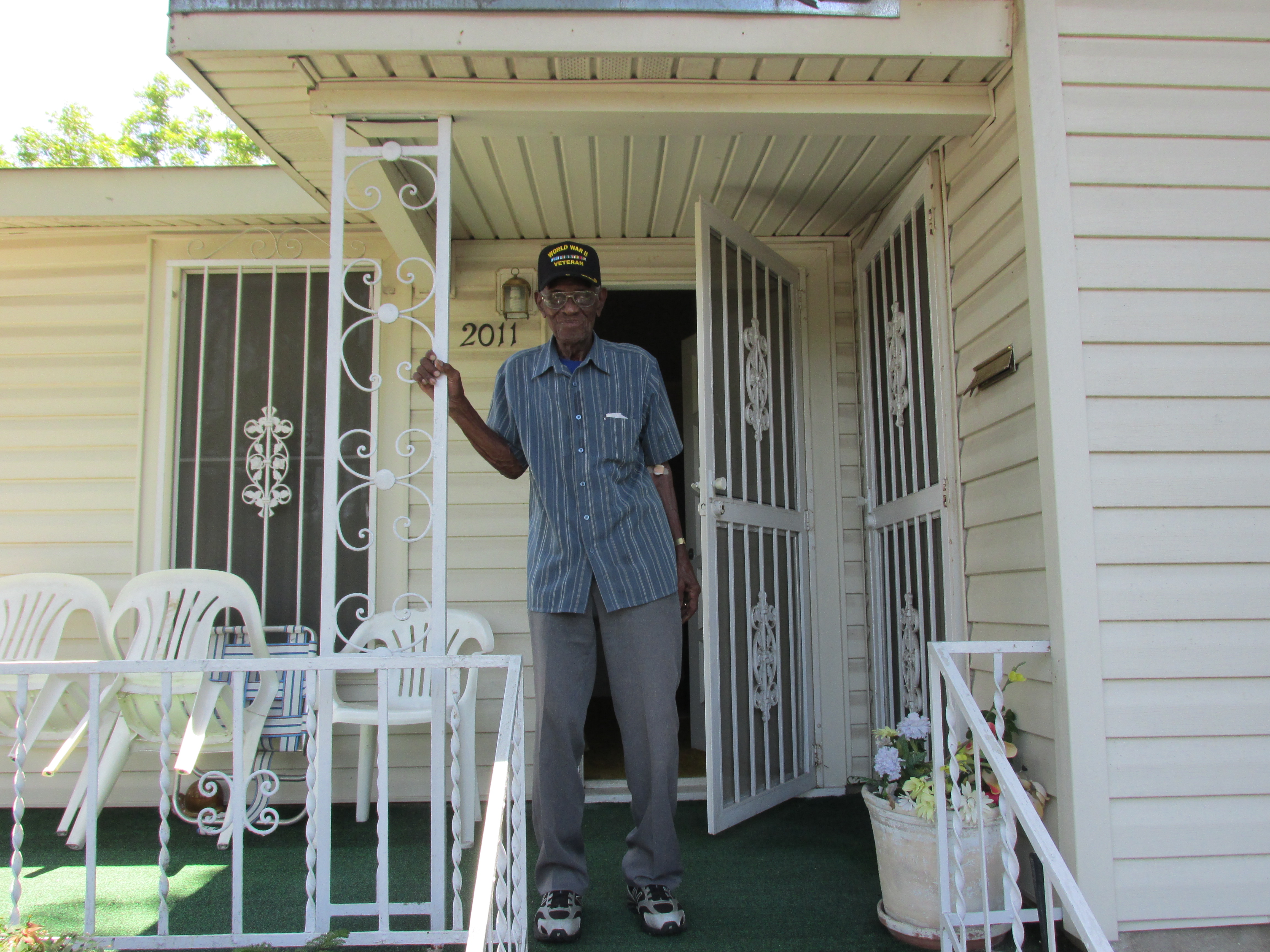
Richard Overton was born May 11, 1906. That makes him 107. While notable itself, what is most interesting is Overton is the oldest World War II in Texas.
That’s according to Allen Bergeron, City of Austin veterans consultant, who says Overton also may be the oldest WWII veteran living in the country. (The Department of Defense and the U.S. Veterans Affairs cannot confirm that, by the way.)
Last week I spent an hour visiting with Overton at the modest home he built in East Austin shortly after he returned from the war.
I waited a few minutes with Bergeron for Overton to return home from a doctor’s visit. Soon an old two-tone green pickup puttered up the street with Overton at the wheel. He slowly inched into his driveway, stopped, backed up, and tried again. Wearing a tan derby, Overton emerged, shuffled over in New Balance athletic shoes to greet us, and invited us inside. He was accompanied by his eighty-nine-year-old friend Erlene Love, a cheerful woman who used two canes to transport herself up the steps and through the front door.
Overton sat in his favorite recliner in his living room and told what he could remember about growing up in the country and his service in the war. As he spoke, I noticed an ashtray on a side table with four snuffed out Tampa Perfecto cigars. He smokes several cigars every day. He also drinks whiskey in his coffee every morning.
Overton was one of ten children who grew up in a farming family in St. Mary’s Colony, a black farming community in Bastrop County, Texas. The community was founded when former slave owners provided the two founding families with 2,000 acres of land, according to the Texas State Historical Association’s Handbook of Texas. After World War II many people moved to Austin for employment rather than endure the hard life of dry-land farming.
Overton helped picked cotton on the farm and hunted quail, rabbits, and squirrels. He made money by serving as a hunting guide for wealthy folks wanting to bag wild game.
“I had some bird dogs. I sold some bird dogs for $100 a dog. Anyway, these hunters they come out of town and they have no place to hunt. They come out in the country and I know all the places to hunt. Anyway, I’d go out with them. And I killed a lot of birds and gave them to them. I was a good marksman.
I was twelve years old I started shooting. Shotgun. Now I got pistols here. I got five. Five of them in here now. I’m sitting over one now. In this chair. Oh yeah. I sit with one underneath. People come in here, this is my chair. You don’t know who come in. You don’t know what they do.”
Overton was fuzzy about when he was drafted. First he said 1944 and then 1941. His Department of Defense DD Form 214 shows he served from September 1942 to October 1945. His record lists him as a “rifle expert” and he served in the Pacific theater. He was in an all-black unit and served in the infantry and as a driver for white officers, he said. Among other places, he was stationed in Palau, Guam, and Okinawa. He often was shipped out without knowing his destination. “You couldn’t think where you were, what Island you were at.”
What was your job?
“Well, I drove a truck, and fighting was one of them. (Laughs). My biggest job. And I was a good marksman. I could shoot good. And they put me with the officers. And I had to stay with the officers.”
Where these all white officers?
“Yeah, all white officers now.”
You saw battle too. Saw combat?
“I sure did. Over my head and between my legs. What’s that? That’s fun ain’t it? Had bullets flying all over me.”
How did you escape getting shot?
“I guess that fellow up above,” he said, pointing at the ceiling. “I didn’t get a scratch on me.”
You were a good shot?
“Well, you had to shoot where they were shooting if you seen them. And if you don’t seen them anymore you must have had a good shot.”
Do you think you shot some of the enemy?
“I know I did. I know I had to. Had to do it, had to get it off first.”
Are you proud of that service?
“I was proud when I got out. When I got in it was all nerves. I didn’t know. I’ve never been a war. But I could always shooting a gun,” he said, his hands clasped on his lap as he sat in his padded chair.
Lately, Overton has become a celebrity of sorts. In May, the Austin City Council passed a resolution in his honor. On Memorial Day, Gov. Rick Perry paid a visit, sat on his front porch, and talked with him while reporters and TV news cameras took it all in. The governor brought gifts: a box of cigars and a pint of Maker’s Mark whiskey.
What do you think of all the attention you’ve gotten lately?
“Really surprised. It helped me a whole lot. I ain’t got nothing but it helped me.
How did it help you?
“It makes me feel better. I never had nothing happen to my life, except about the Army. I’m glad I’m over the other boys I wish they were same age. I don’t know why I’m so old and they so young.”
You know that you have outlasted just about everybody? You’re the oldest WWII veteran in Texas and one of the oldest in the country.
“That’s what I heard. They didn’t know that until all the people told me. I didn’t know that. I couldn’t keep up with the soldiers.”
Bergeron motioned it was time to go. Overton needed to eat his chicken wings for lunch and rest.
But first a few photos.
“Just help yourself,” he said when I asked to shoot his picture. I reached for my camera.
“Are you going to eat now?” Bergeron asked.
“No, I’m going to take my picture. Oh Lordy,” he said.
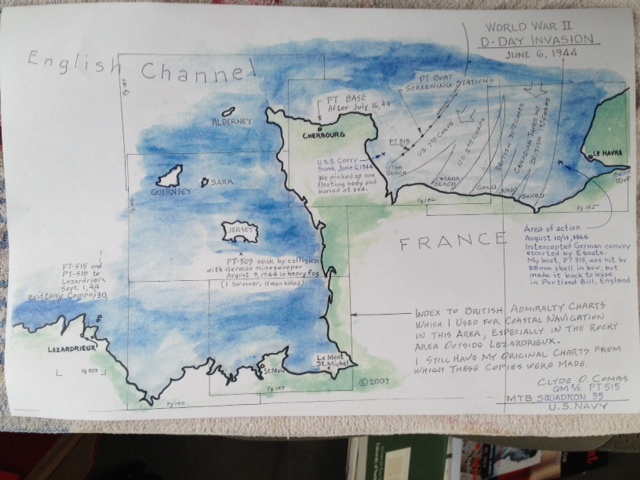
On June 6, 1944, Clyde Combs was aboard PT 515 looking upon history’s largest amphibious landing before dawn.
All he could hear was the constant drone of U.S. and Allied bombers flying above, thunderous shelling from nearby battleships. About one-third of a mile away, soldiers waded to shore.
Combs was a nineteen-year-old quartermaster on the speedy PT boat, one of dozens lined up on D-Day to guard the western flank of the invasion force that marked the beginning of the end of Germany’s occupation of France and Europe.
In his upscale west Houston townhouse he shares with his wife, Virginia, Combs, 88, told me the story of his life before and during the great war. I learned about PT boats, speedy eighty-foot-long boats made of mahogany that FDR insisted the War Department build at a time that U.S. Navy more favored big battleships.
Combs gave me a copy of a drawing he made of the D-Day invasion showing where his boat was stationed and then other encounters his PT 515 was involved in during the ensuring months off the shores of Normandy. It’s hard to make out on this copy, but Combs noted on the drawing his boat picked up a dead seaman floating in the channel later in the day on June 6 following the sinking of the USS Corry destroyer, which struck a German land mine.
Heino was an eighteen-year-old German infrantryman when this photo was taken in 1942.
Heino Erichsen was born June 7, 1924 in Kiel, Germany, a Baltic Sea port. When he was nine years old, Adolph Hitler became Germany’s chancellor and led the country into its irrational and destructive decade that led to perhaps the world’s largest and most gruesome war and ethnic persecution.
When he was growing up, Heino was among many thousands of German boys who became members of Hitler Youth, a compulsory military indoctrination program of the the German war machine. In May 1943, a month away from his eighteenth birthday, Heino was drafted into the German Army and sent to boot camp in Denmark, where he trained to fire machine guns, and within months he was a member of the German Afrika Korps sent to North Africa to fight a losing battle against the Allied forces. He was taken as a prisoner and shipped with hundreds of thousands of German prisoners to newly built POW camps in the United States. After arriving in New York and deloused, Heino was put on a train to Hearne, a little town in East Central Texas.
Heino was among as many as 4,800 German POWs who lived at Camp Hearne, where the government built 250 buildings: barracks, hospital buildings, guard towers, administrative facilities, mess halls and a building that prisoners converted into a 200-seat theater. The barbed wire that fenced in the POWs would line 1,800 miles, more than enough to stretch to Chicago.
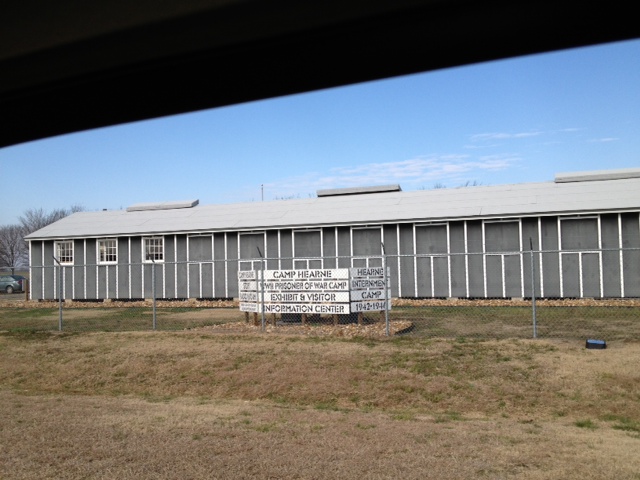
Camp Hearne POW camp now houses a museum.
Hearne city boosters had successfully lobbied the War Department to build the camp just outside of town as a way to bolster the local economy. It was among the largest of dozens of facilities in Texas that housed POWs during World War II.
Most of the German POWs at Hearne were noncommissioned officers, hard-liner sergeant types who were strong believers in the Third Reich. “We had some scary guys,” Melissa Freemen told me Friday during a tour of the Camp Hearne Exhibit and Visitors Center.
From all indications, Heino was not among the scaries. This morning I met Heino at the independent living facility he lives in The Woodlands, a little more than an hour’s drive from Hearne. He greeted me with a smile and lightly touched my arm as he shook my hand. His demeanor is of a kindly, gentle man in a cardigan sweater.
Speaking in a s German accent, Heino recalled that he spent most of his days as a prisoner working in local farms, shearing sheep, working with cows and plowing fields.
Heino was a lowly private in the German infantry, and was compelled to labor in the fields. But the German officers in the camp, roughly eighty percent of the prisoners, were not required to work, which is a provision of the Geneva Convention, the international agreement that governs the treatment of war prisoners to which the United States abided. The officers spent much of their days in recreation, playing soccer, going to classes, staging plays, crafting artwork and woodworking projects, and building gardens and water fountains to beautify the 700-plus acre site.
After the war, Heino went back to his hometown in Germany, and lucked into a cushy job: as a translator for a British government official who managed two German counties. But he never forgot Texas. In 1953 he emigrated to the United States with his young German bride and their son. He worked as an accountant at a hospital in Minnesota, and eventually divorced and became a single parent to his son. He met Jean, a Minnesota native and also a single parent, and they married in 1962. They both earned master’s degrees (his in business, hers in counseling). They adopted three children from Colombia and moved to Austin, where in 1981 they launched what the Erichsens say became the state’s first international adoption agency, Los Ninos.
Three years ago, after placing 3,000 orphans from 20 countries into new homes, the Erichsens retired and closed the agency and they now live outside of Houston.
These days, Heino is a celebrity of sorts at the Hearne camp, where he frequently visits to speak about his life and his experiences. “I’m the only former prisoner who came back and became a U.S. citizen and live in Texas,” Heino said. He co-authored a book about his life, “The Reluctant Warrior: Former German POW Finds Peace Texas.”
Nearly seventy years after the end of WWII, Camp Hearne is a shadow of its former self. The only original structures that remain are a water pump house and a small structure for a water well (both were renovated with a brick facade by the city long ago). The museum maintains eleven acres, where there is a newly built barrack that houses displays of artifact, photos and exhibits showing how the POWs lived and worked. Outside, is recently completed a guard tower.
Across the road from the museum, I walked about one-third of a mile down a path that long ago went down the middle of one of the three POW camp compounds. You can make out numerous concrete foundations on both sides that seem to want to be taken over by the scruffy underbrush, weeds and mesquite. You have to use your imagination to see thousands of German prisoners, dressed in Army fatigues with “POW” stamped on the back and wearing shorts during the hot summer months. Some sit on stoops, eyeing visitors walking this way, while others go about their activities, perhaps kicking a soccer ball or telling a story in German.
The Kneeling Lady Foundation built by German POWs once had an elegant kneeling woman holding a platter. Three frogs positioned on the edge of the fountain sprayed water onto the platter.
At the end of the path, in a small circular clearing, there is the remnants of the Kneeling Lady Fountain, an elaborate construction that once featured a kneeling woman on a pedestal holding a platter. A photo in the museum shows an artistic creation, a Greek-like woman in the middle of a pool, with three cement frogs that spouted water onto the platter she held. An exhibit case in the museum holds portions of the frogs. If you try, you may very well hear trickling water and the spray from the frogs.
Features such as this were uncovered by Mike Waters, a Texas A&M anthropology professor who has explored the site and wrote a book about the camp, “Lone Star Stalag.” His work helped inspire Cathy Lazarus, a retired pharmacist who led the creation of Roll Call, Friends of Camp Hearne, the nonprofit organization that opened in the museum in 2011 with community support. The museum preserves the history of the POW camp. It is well worth the trip, especially if Freemen and Lazarus provide you a personal tour. Learn more about the museum on its website.
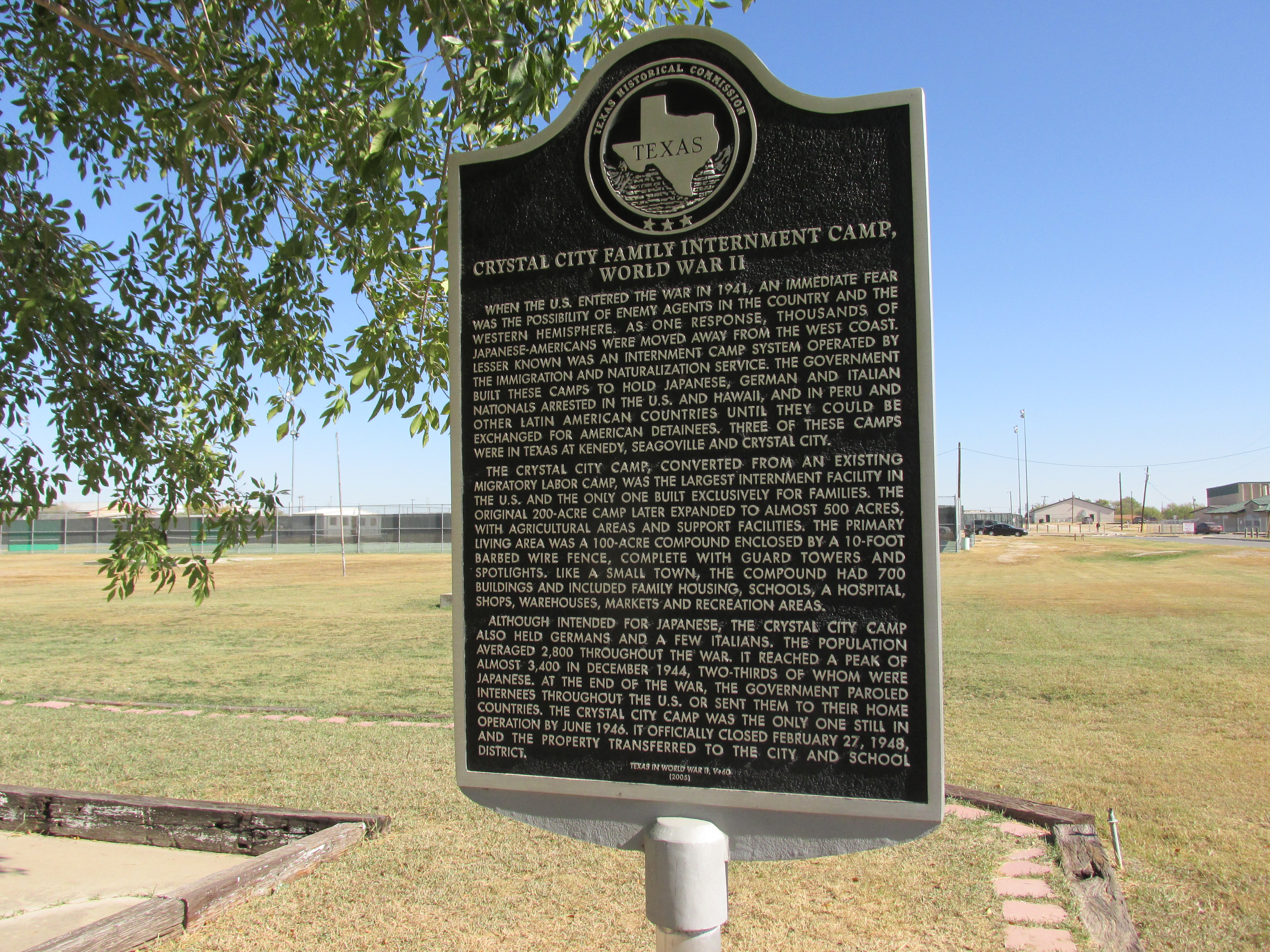
During World War II not all the internment camps established by the federal government were in California. Several of them were created in Texas, with the largest one in Crystal City built on the grounds of an old migrant farm worker camp.
A water tank near the camp’s pool was spray painted with information about a 2002 reunion of internment camp detainees.
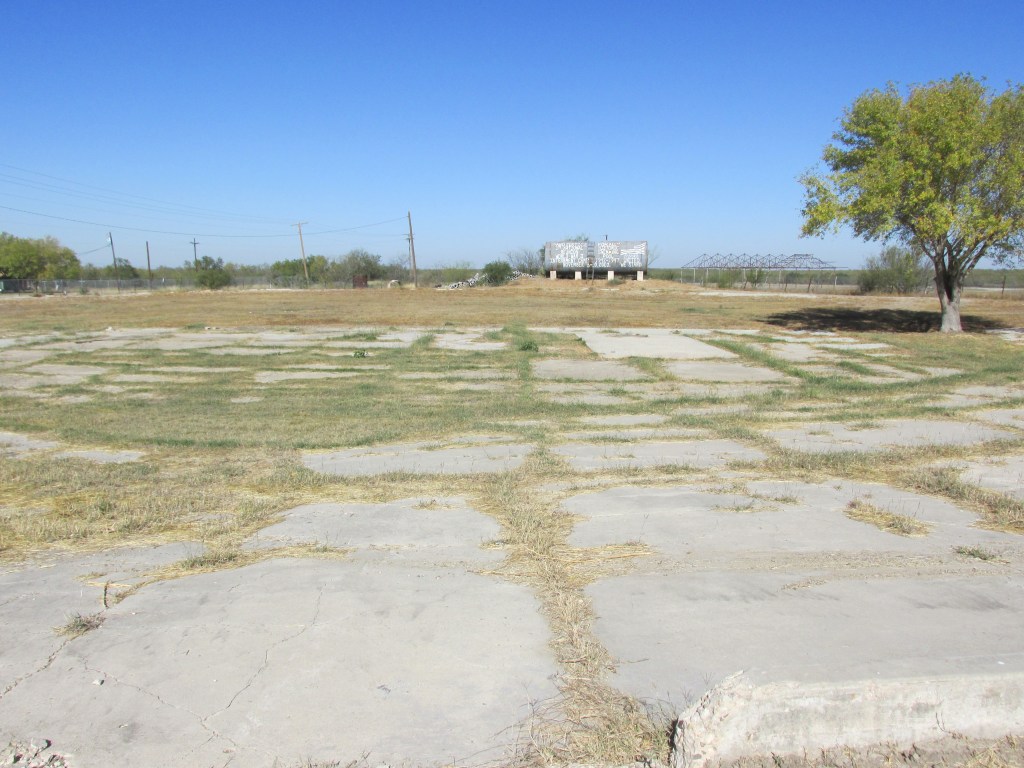
Other than some historical markers and informational signs, you would be hard-pressed to find any evidence of the old camp, which has been taken over by two schools and athletic facilities operated by the Crystal City Independent School District and a part of the dormant municipal airport.
There is no museum or visitor center. Nor a fence or guard towers or buildings left standing from the camp. But you can find evidence. My guide was Buddy Guyler, a history buff and amateur anthropologist, who attended middle school on the property in the 1950s. He showed me foundations of old administrative buildings and homes for camp supervisors that sat just outside the fenced camp. We visited the remnants of a large circular pool that internees built in an irrigation tank. It was the best swimming pool in town and Buddy remembers sunny days when he cooled off in it when he was a boy. You have to use your imagination to see hundreds of camp buildings, small homes and other camp structures that once housed thousands of internees and their families. Many of them were born and died in the on-site hospital.
I visited the Crystal City Library and a helpful librarian brought out an old box of letters hidden in a filing cabinet in a hallway. The letters were addressed to a German internee, Walter Steiner and his wife Gerda, and came from friends and relatives in Germany, California and Port-au-Prince, Haiti. Some of the letters were mailed in 1946 and 1947, more than a year after the end of World War II. The envelopes were stamped to note they were examined by a censor. One letter writer said that she hoped the Steiners can be discharged soon and remain in the United States because conditions in Germany are “none too good” with strict rations on food — too little to live on and too much to die.
Later, as darkness approached, I drove down a dead-end street to see if I could find some structures that I was told still exist at what would have been the back-end of the camp property, near a city dump.
I stopped in front of the last house, where debris was aflame near a driveway, a way the homeowner discarded trash. I asked the man who was standing out front whether he knew about the internment camp.
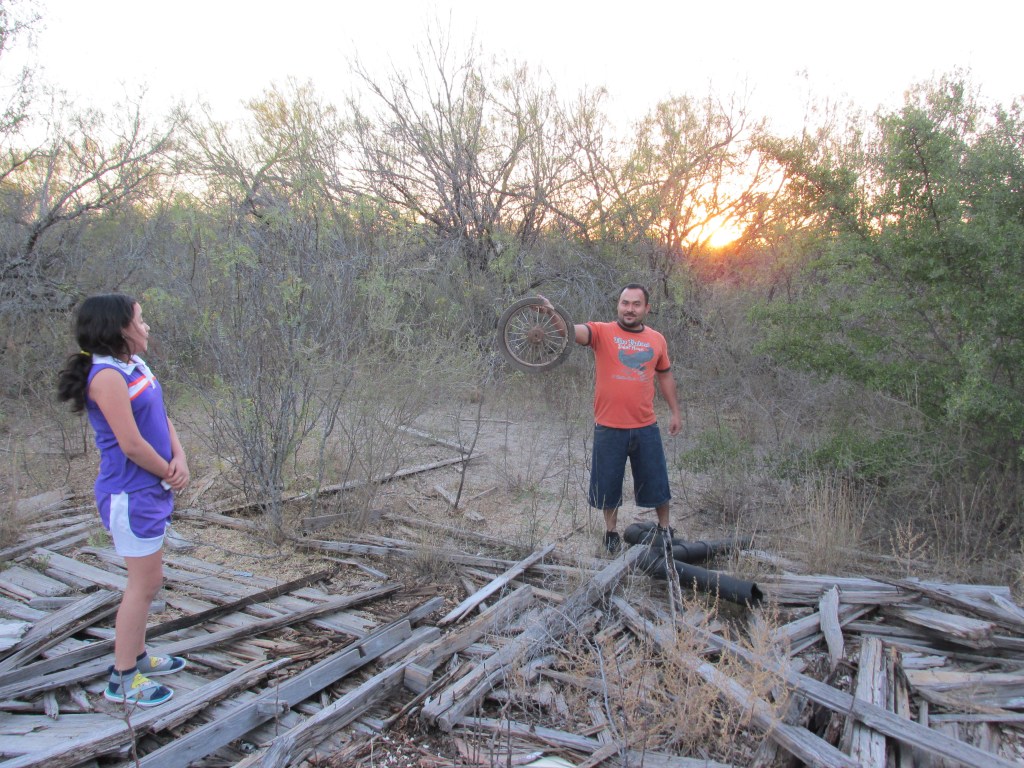
“The concentration camp?” said Manuel Gonzalez, the homeowner. “Yeah.” He said that the buildings were all collapsed, but he was quite happy to let me take a look. Manuel and his 10-year-old daughter, Aaliyah, led me down a little-worn path, pushing past overgrown bushes and stepping around prickly pear cactus, and soon we stood in front of what may be the only on-site wooden remains left of the camp, five large piles of wood where five buildings had collapsed. One after another, we poked through the mounds of broken boards and shingles and junk and found a few relics: a bicycle tire, shoes, bottles and ragged slacks. The largest of the buildings appeared to have been a school. Manuel said desks were found there, and a rusty metal skeleton of a chair. Manuel said while he was growing up he combed through the wreckage and his brother once found a SKS rifle that had Japanese writing on it.
I left with a piece of a door that still had a rusty door knob attached. I brought it to Buddy’s house to see what he thought and for safekeeping. He said the old gray pine wood didn’t immediately indicate it was from the original camp. He said the first buildings were built with redwood. I left in the dark. The next day I spoke to Betty Fly whose father was a supervisor at the camp and to Virginia Payne who worked in the camp post office.
“I felt sorry for them because because they were uprooted and hauled off,” Virginia said. “I always wondered how they felt. I felt they were treated well. They had everything they needed. I know it wasn’t a good time for them and I felt bad about that. But underneath all that we still had to remember we were at war.”
I’m in contact with one internee who was born in Germany and whose parents moved to Cincinnati when he was a young boy. He was arrested while in high school one day and sent to the camp where he spent a good part of the war. He tells a riveting story and I will write about it in my upcoming book. I’m searching for Japanese internees who can shed a light on that time. Write me if you have leads at charles@charlesboisseau.com.
Sign includes a photo of a graduating class from the high school that internees attended.
Manuel Gonzalez shows an old tire he found while his daughter looks on.
This shows what remains of the circular pool internees built.
A letter sent to a German internee more than a year after the end of World War II. Note the letter was examined by a censor. The letter writer says that she hoped the internees, Mr. and Mrs. Steiner, can stay in the United States because conditions in Germany are “none too good” with strict rations on food — too little to live on and too much to die.
HIstorical marker near foundations of buildings that were located just outside the camp fence. In the background you can see school facilities that take up much of the old camp site.










 Charles Boisseau